
Odyssey
INTRIGUED BY THE HUGE WAVE of media attention to Christopher Nolan’s new film version of Homer’s Odyssey, my husband and I went to see the film last week. He wanted to see it in an IMAX cinema, so we booked the tickets on a Monday to take the two-hour drive to Bordeaux the following Friday to see it.
Over the course of the week, it became apparent that, although not as beset by monsters as Odysseus’s journey, it was not going to be the carefree venture a trip to the cinema usually is.
On Wednesday, a fire had broken out 30 km to the west of Bordeaux, in the environs of Arcachon. We kept an eye on the news and its development. As it hadn’t reached Bordeaux, and as we had booked the (nonrefundable) tickets, we decided to go.
It was a blazing Friday, of a piece with the rest of this freakishly hot summer. A sky that glowed with its own blue intensity in the absence of any clouds. The sun like a furnace in the middle of it. We visited cafes in the shade and the Musée d’Aquitaine to take the bite out of the heat. But works on the tram line across the Pont de Pierre required a 10-minute walk across heat-reflecting pavement and river in full, radiant sun, the heat like a weight across our shoulders as we dodged and were dodged by cyclists and e-scooter travellers as eager to get to the other side and the shade of buildings as we were.
Cinemas, as usual in the summer, are an oasis of climate-controlled cool. We drank what felt like our bodyweight of cold water, then found our seats.
The Odyssey has always been a well-loved story of mine. When I was a kid, I had an abridged, child-friendly (and child-appropriate) version of it that I read over and over. But even that can’t prepare you for the hit you get when you encounter the original. The gravity and richness of the intertwined narratives, each with their own sense of peril and suffering: the daring exploits and sheer, super hero-like bravado of Odysseus, along with his foolish hubris; the few examples of human truth, goodness and dignity among the throngs of men rendered ferocious and pitiless through greed and war.
I was keen to see Nolan’s take on the story. For a start, the Olympic gods were out, no more of a presence than any of our own gods. I understand the desire to leave them out – the film Troy in the 00s had also effaced them from the screen. But I always kind of miss the entertainment of their petty cavilling and grand gestures. I think, too, there is good reason to include the mess they make of things with their omnipotent meddling. What a cogent expression of our own interference in the workings of the Earth.
Nolan took a different direction. Matt Damon’s Odysseus is world- and war-weary, horrified at the descent of his colleagues into brutal, elementally vicious and violent creatures, acting with neither reason nor compassion. Horrified at his own complicity and descent into such a state, he careers from one disaster to another.
You could almost make a case for his entire trajectory from Troy to Ithaca as an elaborate hallucination brought on by PTSD and drugs. Yet, tragically, the violence doesn’t stop with his homecoming. We are projected into a scenario in which avarice drives men into wars, but also provokes intolerable behaviour and suffering far from the battlefield. And, rather dubiously, he succumbs to it again himself in one final act of vengeance.
Rather shaken from this end-of-days scenario, we took the public transport boat service this time to avoid the trek across the bridge. It zig-zagged across the Garonne River, bringing us finally to a tram station. As I stared down the track during the inexplicably long wait for the tram, I wondered that the air seemed to have become thicker, an entity of its own rather than something to be looked through. As this continued, I realised the wind must have turned, blowing smoke from the fire into the city. By the time we reached the car, everything was in haze.
It took more an hour to get out of Bordeaux from our park and ride near the northern outskirts. The traffic was unusually heavy. The GPS took us on a meandering journey, full of stops and starts, trying to avoid backups. And I realised, looking at the number of international number plates and full caravans around us, that we were in the midst of an evacuation. Holiday-makers from all over Europe, people who had somewhere else to flee to, were escaping home. Images of those who didn’t have that opportunity came in through the news: people assembling in large sport and multi-purpose venues who might never see their homes intact again.
Since last Wednesday (five days ago), at time of writing, 42,000 hectares have been ravaged, and 220,000 people have been evacuated.
We eventually pulled out of the traffic to our exit, and continued our way home on more open roads. But across the horizon to the west, a long, muscular plume of smoke – grey, brown and rust-red – extended and reclined across the sky, taking on the glow of the setting sun in dull reflection of the flames that had caused it. Smoke that was adding to the carbon trapped in the atmosphere, increasing the climate heating that exacerbates conditions leading to fires such as this, and those all over the world. And we continued our own wandering journey home – our car emissions, though on a more diminutive level, doing much the same.
Still in the emotional grip of this movie, it was impossible not to think of present-day moral deterioration, our hubris and avarice, untempered by reason and common sense, bringing about the destruction of our very real world. Our habitat and the basis for life as we know it on Earth.
On screen, we watched the fires and unspeakable violence that accompanied the final battle that destroyed the great city of Troy and its people. It seems we can also watch it here, around us, in real time. A slow-motion inferno of our beautiful planet. Apart from our eventual destruction with our environment, it’s to our shame that our legacy as creative, intelligent beings is literally going up in flames.
Chimps and fire
I was struck by a line in Samantha Harvey’s novel Orbital – I mean, I’m struck by almost every line in this profoundly beautiful book – but this sparked an immediate internet trawl.
‘… the only things humans can do that animals cannot is start fire from nothing.’
Harvey goes on to say that chimps could do it if they watched and learned, and then they’d be doing more human things like cooking food and moving to cooler climates.
This is a phenomenal concept. I instantly looked up whether chimpanzees could be or even had been taught how to make fire, and it appears they have been. But they have to be taught, they can’t come up with the concept themselves, nor an idea of how it could be useful to them, now or in the future. Apparently. I don’t know anything about chimps.
So that difference in cognition is the decisive element? Chimpanzees – I think probably most apes and many other animals besides – are hugely curious. A lot of them make tools and come up with solutions to problems using them. How is it that a sense of the enormous benefits of harnessing fire, despite its dangers, is such a game-changer? We can see what it did for the human species and what progressed from here, but what of this epoch making or breaking moment of cognition?
It made me think toward, if not an opposite end of the spectrum, at least a very different part of it. Can AI “think” of making fire in this way? Is it endlessly curious the way a human being is, endlessly able to put two and two together and make 500?
The fire on the tea light in this photo was not created with a piece of flint, nor an existing ember, nor a match or even a conventional lighter. It was done with some stick I recently bought that can be recharged with a usb cable that creates a little laser horseshoe like something out of a dated Frankenstein film to light the wick without fire. It’s like a toy. Every time I use it I’m amazed.
Unfortunately I can’t come up with some kind of tight and pleasing conclusion to this train of thought. I can hear some symphonic music playing on an internet radio, see the cursor blinking on my screen, see the buildings out the window and the jet trails in the unruly and insistent sky … sometimes, frequently, I’m overwhelmed by the enormity of what is in the world, and am endlessly, greedily curious about it. As a fellow human animal yourself, I’m sure you are, too.
Colours from nature to dye for
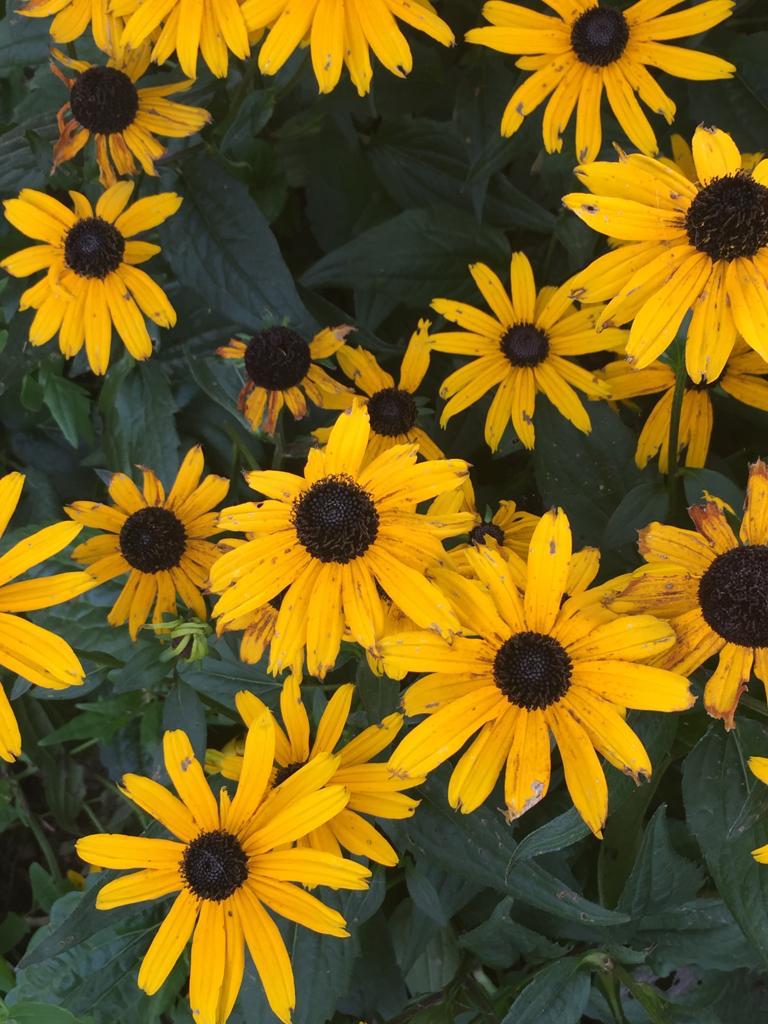
Even common, garden-variety black-eyed susans can yield a handsome ink. Image: Cathy Dillon
Bringing the colours of nature into her work, artist and journalist Cathy Dillon is harvesting local plants to create her own pigments and ink
THE EXISTENCE OF COLOUR is one of the great gifts of the physical universe, and the ability to see and appreciate it is one of its greatest gifts to us. While we can’t detect the full spectrum, the rainbow of hues visible to us represents one of the greatest pleasures and comforts of daily life.
And so on to Dublin, where journalist (and former Irish Times colleague) Cathy Dillon has been going beyond the black and white of newsprint. No longer just writing, she’s exploring a love from her past – visual arts. To do this, she is quite literally going back to the roots of writing and pictorial communication by foraging for and processing plants to to make her own pigments and ink.
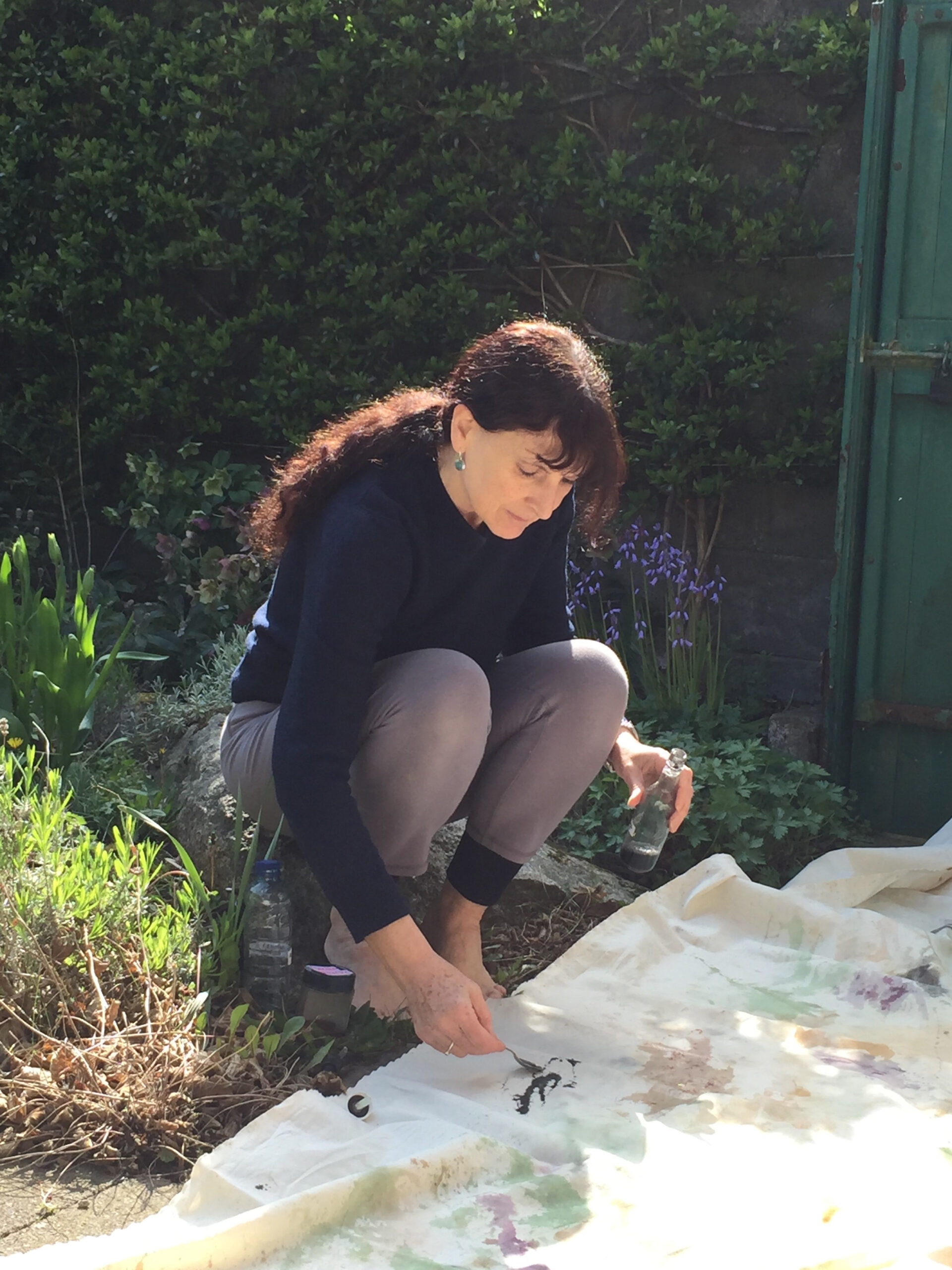
Cathy Dillon at work in her garden
Cathy, who’s always dabbled with drawing and painting, faced into a journalism career path when she decided to study English instead of visual arts. After 17 years at the Irish Times, she decided to go back to freelance work, and has augmented her writing and editing activity with drawing and painting. Making inks is a way of getting back to the foundation of written communication. “It’s the intersection of visual arts and text,” she says. “Letters are beautiful and intriguing.”
She started her exploration into natural pigment production when she embarked on a joint work with another local artist, Áine Teahan. For the Hinterland project, she got the idea to make wild inks with flora from the area. “I started to readbooks about wild inks, and there’s an active network of people who make them,” Cathy says. “I go foraging in the area and experiment with different things.”
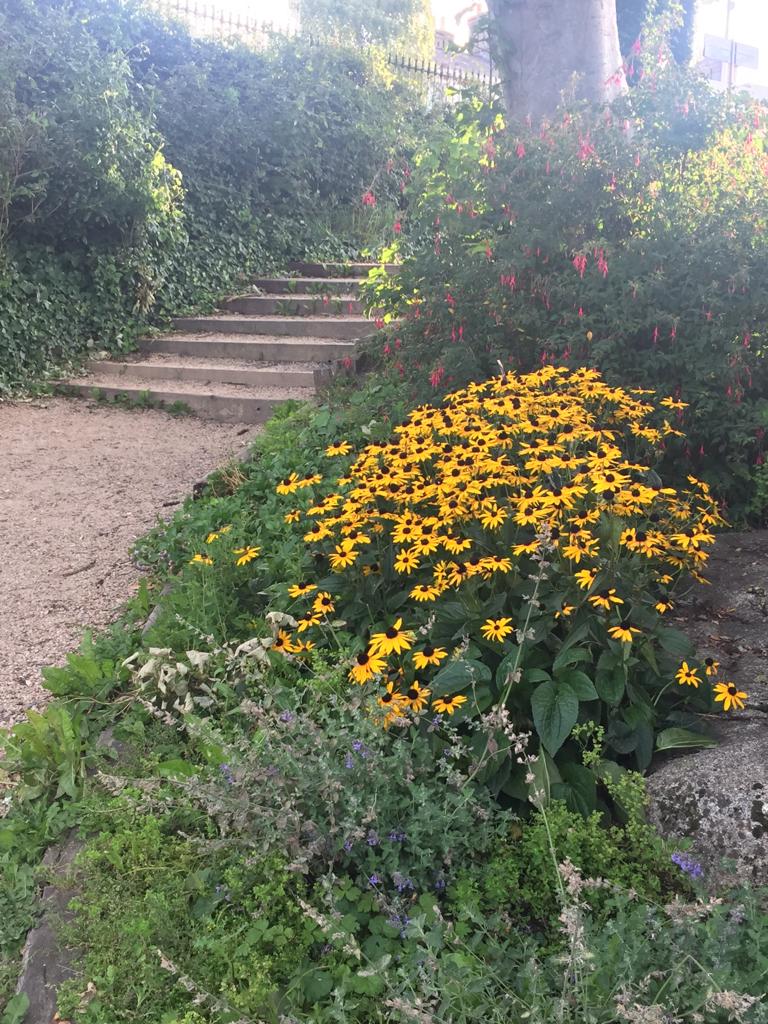
Many plants along your usual pathways could be an accessible source of rich pigment. Image: Cathy Dillon
In that field you’ve just walked through, or that park you’ve crossed on the way to the supermarket, or even just a bit of neglected green, you might have seen some of the vegetation that, properly treated, can yield beautiful pigments for writing, drawing and painting. Naturally growing items such as rose hips, blackberries, fennel, eucalyptus, birch bark and nettles can all be transformed into something into which to dip your brush and bring colour to the page. Most recently, she harvested your fairly standard black-eyed susans, happily growing in profusion along a path near Dún Laoghaire. She says that she always takes care to follow the general rules for foraging: only gather what is abundant. Take only as much as you need. And always ask permission if the plants are on private or publicly owned land.
After harvesting, she says, “You need a couple of hours to make ink, and a couple of days for pigment.” She beings by collecting her source material, pouring boiling water over it and steeping it overnight. The next day, she boils the infusion and lets it steep again. After this, she adds soda ash so that the pigment settles out. The liquid is poured into a coffee filter, which catches the pigment. It takes time, but in the case of the black-eyed susans, for example, “It turns out they make cool patterns as they dry.”
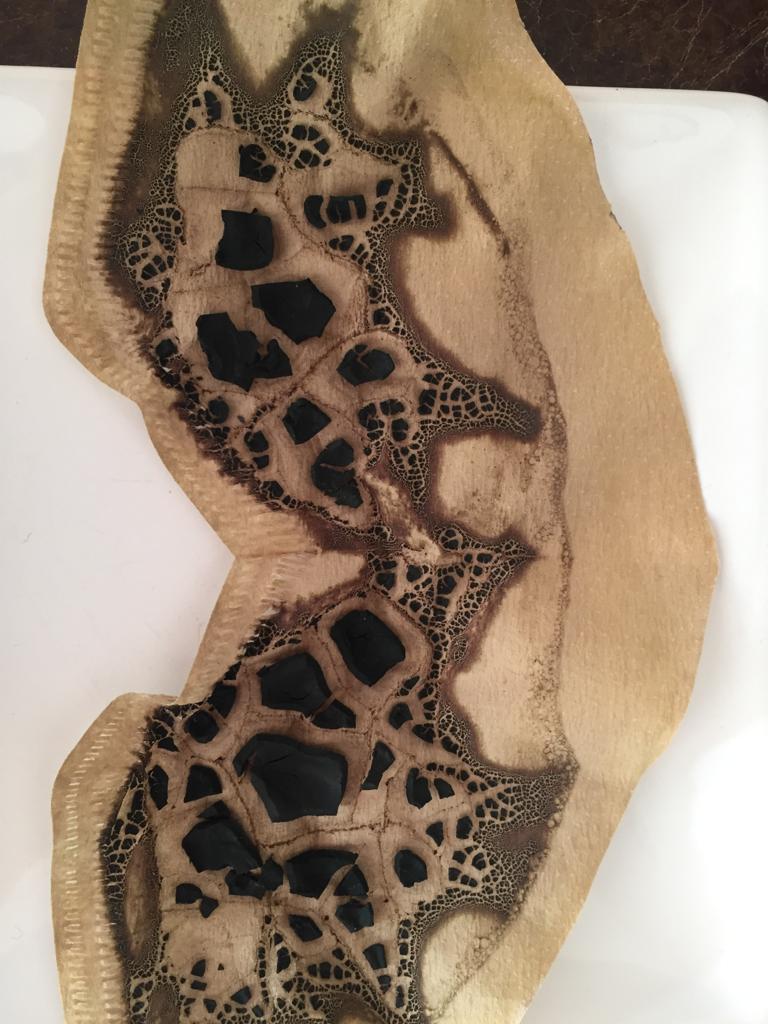
After filtering the liquid from processed black-eyed susan plants, the pigments leave intriguing patterns in the filter. Image: Cathy Dillon
Once you have dried and ground the pigment, you can make your own paints. Mixed with gum arabic (which itself is derived from the acacia tree), water and glycerin, the pigment becomes water colours. But you can swap the glycerin for oil for oil paint, or egg for tempera.
“The three main traditional dye plants are woad, madder and weld,” Cathy explains. These have been used for centuries to create blue, red and yellow pigment. She found woad seeds in an arts supply shop while visiting friends in France, brought them back and scattered them into her garden. “Amazingly,” she says, “they survived, so I’ve made pigment out of that.” She’s also in the process of growing madder. But weld has proven difficult to cultivate. “It grows wild in scrubland and neglected areas,” she says, “and likes poor soil and open conditions”, so the average cottage garden is probably not its favourite home.
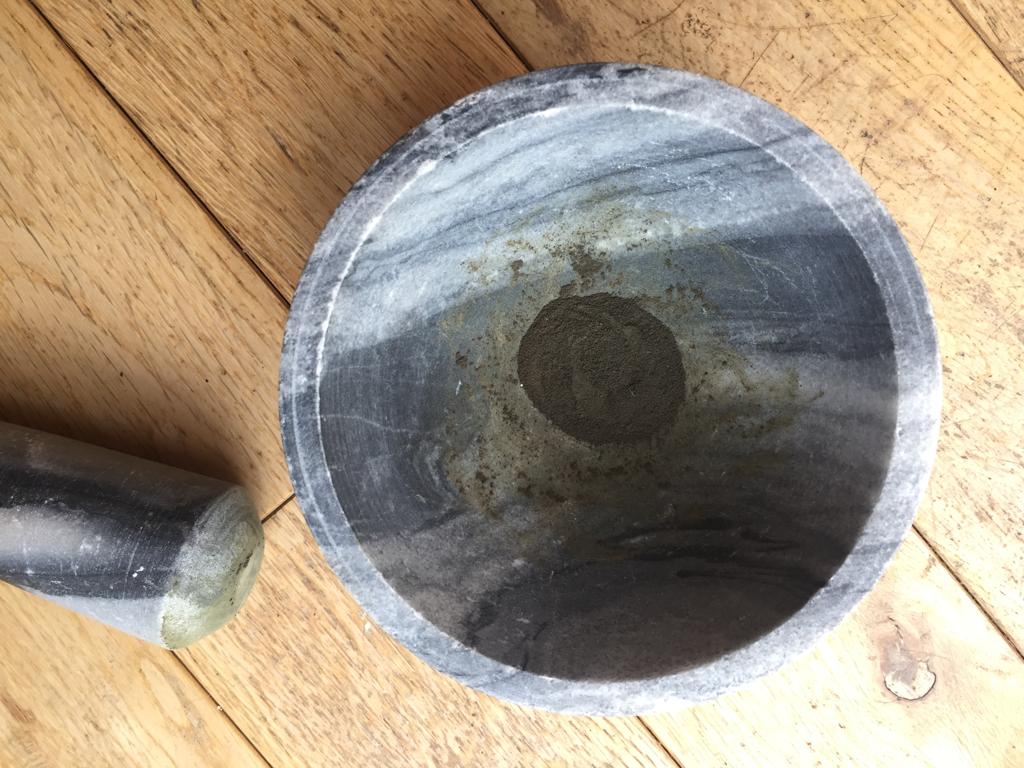
Once dried, the pigment can be powdered for making inks, paints and dyes. Image: Cathy Dillon
“I really like working with nature,” says Cathy, as she describes the advantages of foraging for her own pigments. “It’s environmental: the pigments are non-toxic and you can compost the remains of the plants. Even the chemicals you need to add are not toxic and can be poured down the drain.” And it’s relatively cheap and easy. “You don’t need a complicated infrastructure, and you can make inks out of things you see every day.”
One of the unpredictable things about natural inks is their fugitive nature. They tend to fade more quickly than industrially processed pigments, with different plants having varying staying power. Ink from blackberries, for example, “is vibrant purple, but it fades to a lighter, greyish colour. You just have to accept that.” A natural fixative can help remedy that, as can protective glass for framed works.
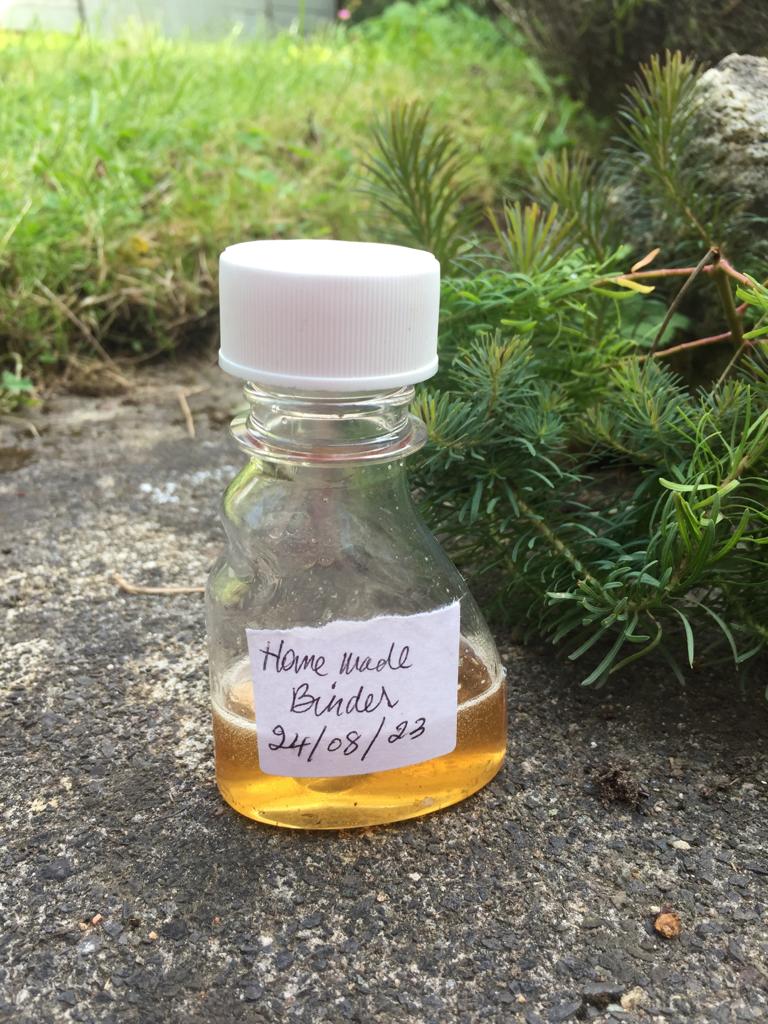
Adding gum arabic to the pigment powder is the next step to making paint. Image: Cathy Dillon
The three traditional pigment plants – woad, madder and weld – became widely used because of their intense and long-lasting colour. But apart from the weld being difficult to grow, the madder takes three to five years of cultivation before you can get that really strong crimson from it. “I did try harvesting some a bit early,” Cathy admits, and although that ruby red didn’t emerge, “I did get a rich orange.” Her best success with these thus far has been the woad, which after one year yielded a vivid blue pigment.
“If you look at tapestries from the Middle Ages, they have this bluish tint,” she says. To get green, the yarn “would have been dyed first with woad, then over-dyed with weld. But the weld fades more quickly than woad, so eventually they go to blue.”
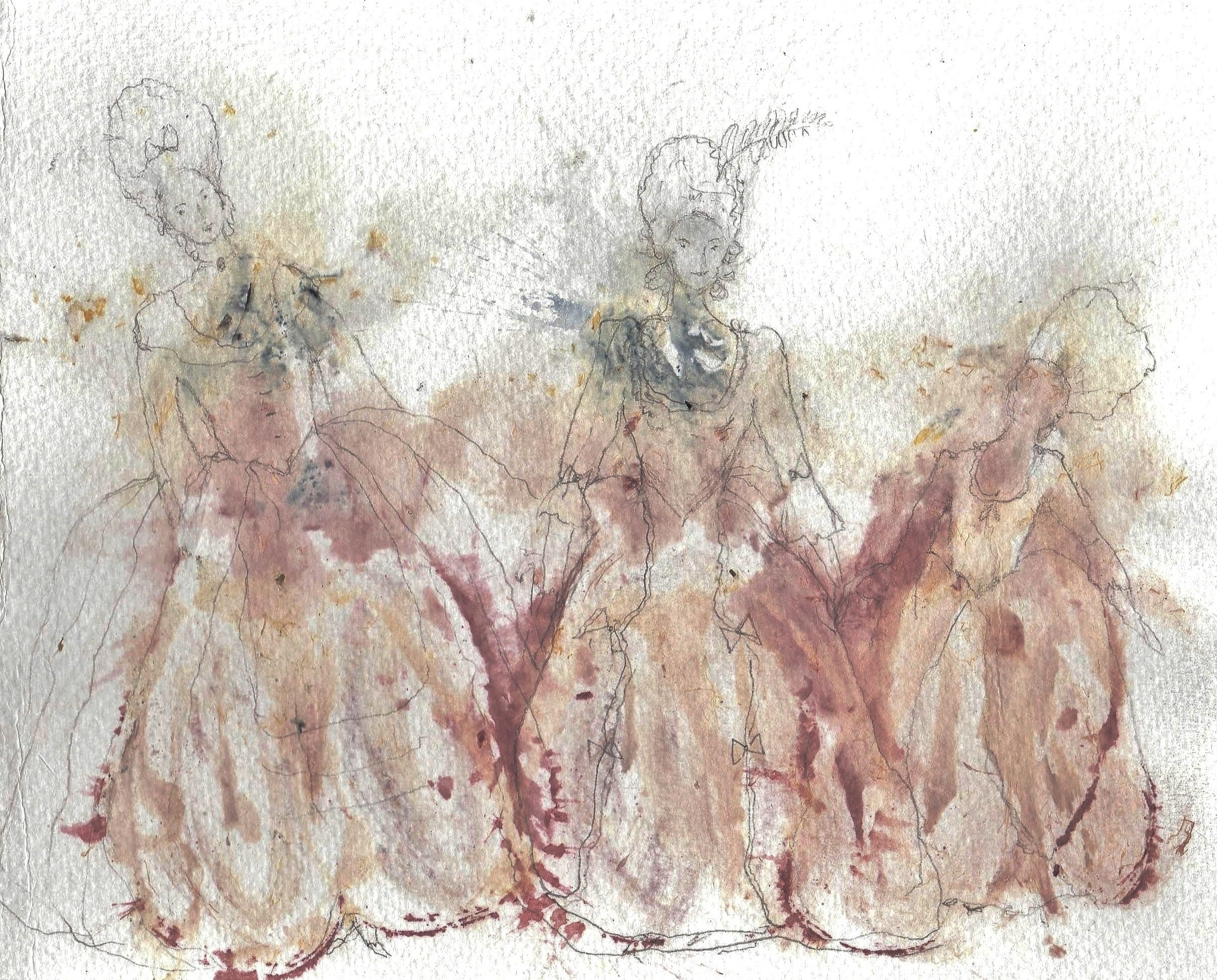
‘Coming towards the end (1)’, by Cathy Dillon, painted with natural inks and pigments
The mercurial nature of the natural pigments can present a challenge, but the excitement of watching what develops brings huge rewards. One thing Cathy has noticed is that, unlike purchased pigments, inks and paints, the natural colours all go well with one another. “The colours are more subtle, and you can get great variety by changing the pH” during processing.
She finds all steps of the process immensely satisfying. The unpredictable conditions of making and working with natural pigments “makes you realise how little control you really have,” she says. She recounts that she was growing some plants for pigments, and then “the snails got at it”.
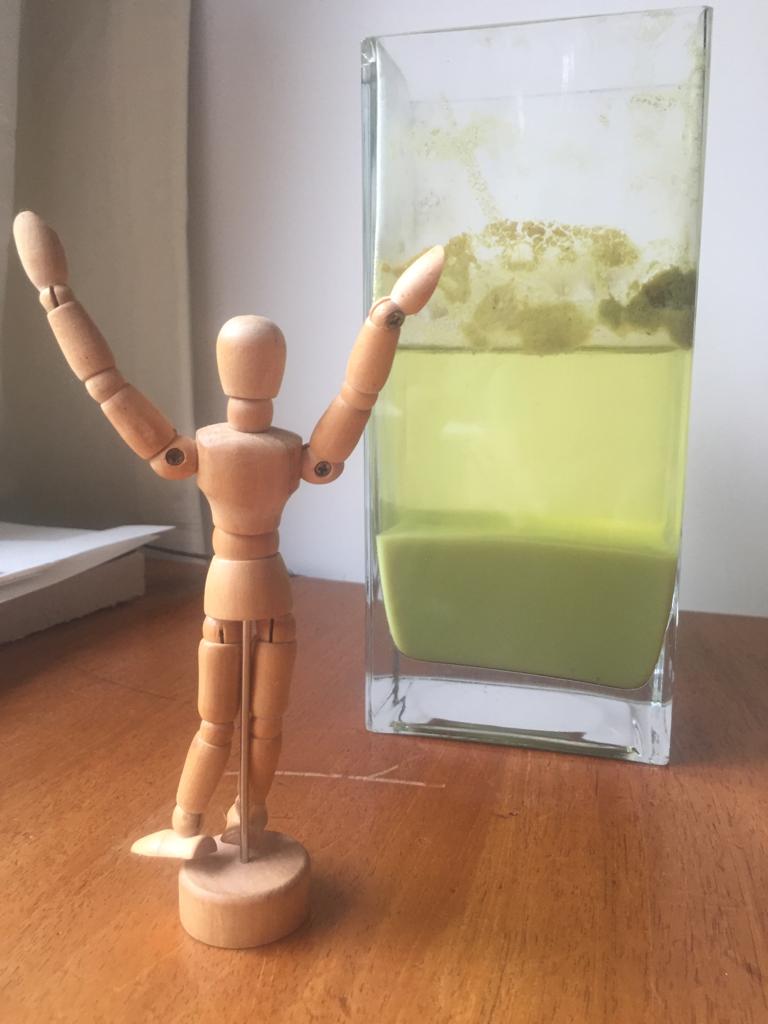
The end is the beginning of this happy process: fennel yields a vibrant green pigment. Here, the pigment is in the process of settling out of the treated liquid. Image: Cathy Dillon
But it’s the act of working with these chance, unbiddable elements that gives pigment-making its added buzz. You discover that you’re less important, “that they take the lead”, she says. “You never know what you’re going to get. It’s great when it becomes something beautiful.”
If you’d like to see more of Cathy Dillon’s work, she has a photographic piece, ‘Lights of Home’ in Artist Network’s Transience exhibition at the Walter’s gallery in Dún Laoghaire, Exhibition continues until the end of October 2023
‘77% down (2)’, by Cathy Dillon, created with her own natural inks and paints
Unstop that writer’s block

Focusing on an object and allowing your mind to free-wheel and make associations can be a useful and productive exercise
Ever sat in front of a blank page or screen and felt like your brain was just as empty? There are ways of breaking free of that state and allowing ideas to flood your mind
Everybody, at some time, will have to produce a piece of writing by a deadline (I actually first wrote “dreadline” by accident, corrected it, then realised what a revealing Freudian slip that was) and won’t have a clue what to write. This is so common that it has its own terminology, and the lead paragraph could have started like this:
Everybody, at some time, will have experienced writer’s block.
And maybe it should have – brevity, as they say, is the soul of wit. But I could probably put that line above into a search engine and get hundreds of articles that start with it. And you’d want to avoid parroting clichés, too.
When I was working for a daily newspaper, where deadlines are excruciatingly tight, relentless and non-negotiable, I sometimes (frequently) got stuck. If things were very bad, I’d leave my desk and take a walk around the block. This would take about 15 minutes, and when I returned, more often than not, the way forward was so blindingly obvious that I was mystified as to why I didn’t see it before. To brazenly seize another cliché: a case of not seeing the wood for the trees.
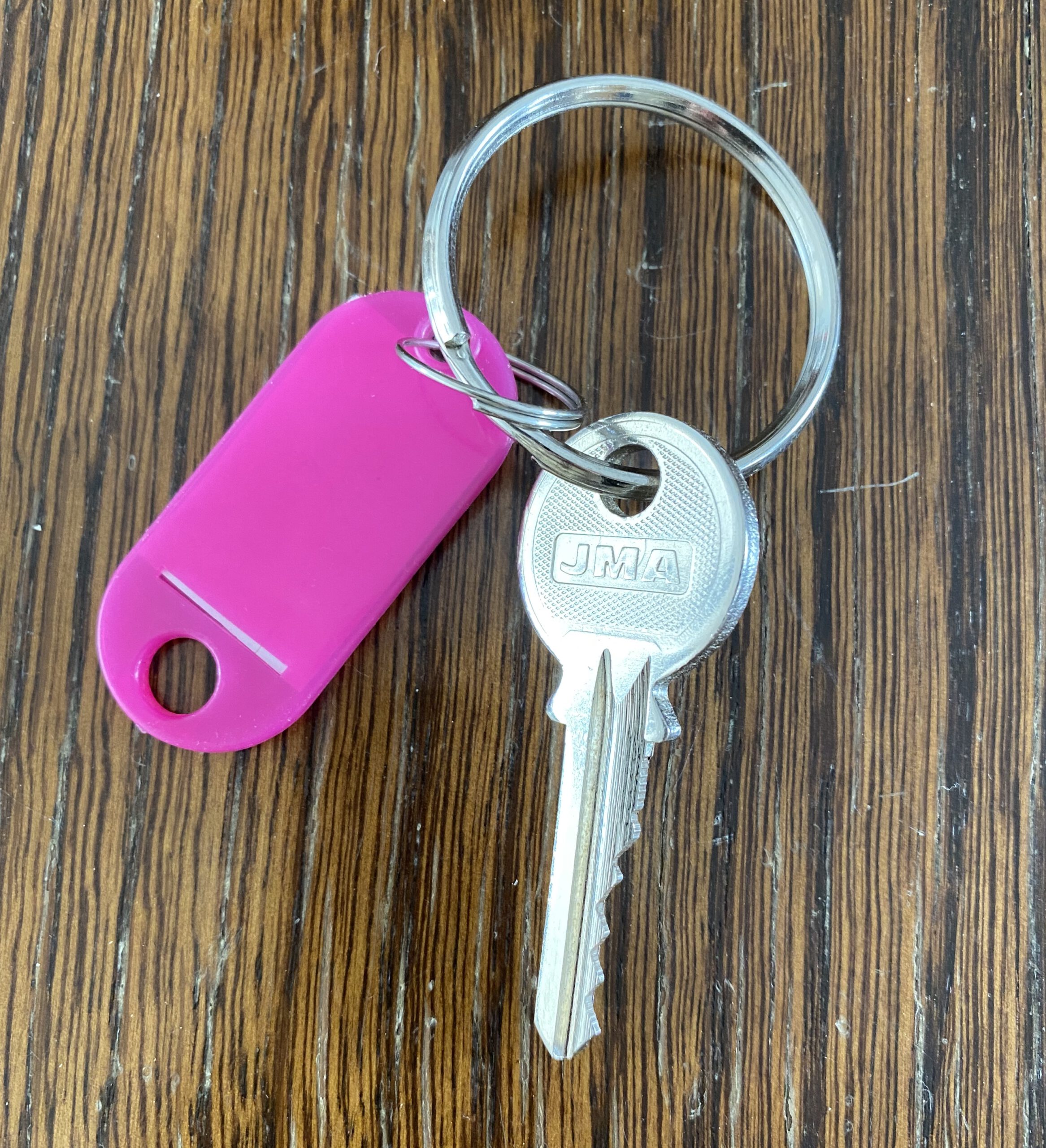
Nothing in your world is entirely neutral, and objects can project the power of myriad associations and stories of intricacy and depth
Creative writing isn’t much different. If you’re blocked, take a break, take a walk, play some music, doodle, emulate Proust and contemplate the madeleine (or biscuit) dipped in your cup of tea. If you’re still stuck after that, here’s a useful exercise not a million miles away from that Proustian hallucination.
Focus on some object. Any object. It doesn’t matter what it is, as long as it’s there in front of you. Stare at a pencil on your desk, or a pen, or your cup, or the crack in the wall. You can go further afield, leave your desk, pick up an orange in the kitchen, or a plate, or a half-eaten sandwich. A used tissue, a rubbish bin, a stray leaf, a hairbrush, a key fob. You’ll have got the idea – anything, it doesn’t matter what.
Stare at this thing and let your mind wander. Whether it’s yours or someone else’s, familiar or strange, dwell on the thing and let your mind go. Don’t try to push into some kind of relationship with it, but just absorb its presence and whatever qualities make it what it is. You will soon notice that your mind is going places with this object, drawing parallels, conjuring up memories, creating hypothetical situations with it. You might be responding to these emotionally. Write these impressions down as they come to you.
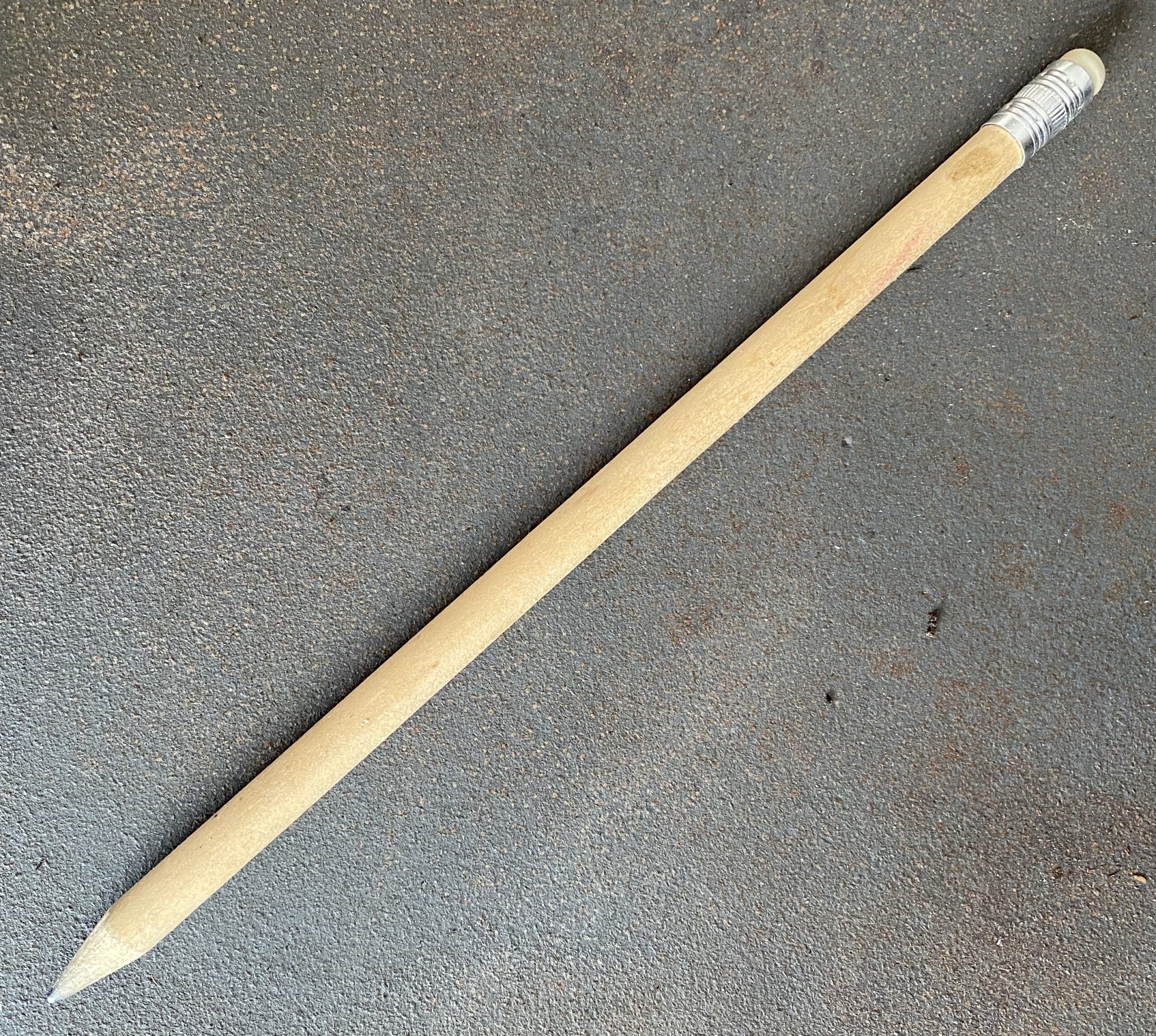
Just a pencil? It’s very pointed, could be a weapon (I did in fact get stabbed with a pencil once, how ironic). Or for many, a wand of creativity. Or the thing that your friend slid on, fell and broke her arm
Let’s take an example. To the left of me, here at my desk, I can see (amongst all kinds of other debris I should put away/throw away but just don’t because clutter clusters around me like I’m magnetic) a selfie stick. It’s black and kind of bulky because it also doubles as a smartphone tripod for taking pictures. It makes me feel a little embarrassed because I don’t want to be the kind of person who uses, let alone owns, a selfie stick. It contains a small remote shutter release that no longer works, which annoys me. I’m remembering the last picture I took with it, when I realised the remote shutter release didn’t work anymore: a family snap at Christmas – taken with the delayed release as the remote no longer worked. I remember the Christmas holiday and the Christmas atmosphere and the glow all around it. A bit more mindless – or rather mindful – daydreaming, and I’ve got an anecdote, or a story, or a memoir.
We can use another example, something totally unfamiliar. Standing at a corner, I see a baby’s lost sock. It’s tiny; I could just about get two fingers into it. It looks machine-knitted with blue and green stripes, and a green heel and toe cap. The baby that lost it, could be either a boy or a girl, might have been struggling with it, nudging its feet against each other, or maybe the sock was too big or too small and just came off. Maybe the child was playing with its feet, or sucking on the toe. Let’s give the child a name: Robin. Why not, we can do anything we like with this. Perhaps Robin’s parent – Pat? – was busy texting and didn’t notice that the sock had come off, or was having an animated chat with another parent and neither of them was really paying attention to the kids in their prams, or the Pat was having a hard day and occupied inside their mind with something else. Maybe Robin didn’t like wearing the socks and managed to pull the one off and was working on the other one before Pat noticed what was going on, but the discarded sock was too far away for Pat to find. Or Pat was in a hurry to get to an appointment and couldn’t go back looking for it. Or Robin had so many socks that it didn’t matter if one went missing. Perhaps the sock was a gift from hated Aunt Sophie, or brother-in-law, and was better having disappeared. Maybe Pat was frustrated at being a parent and it was the seventh sock that Robin had managed to dispose of in a week and they were thinking, fine, just freeze then. Or Pat was convulsed with guilt and felt like a bad parent because they never noticed that the socks went missing, and didn’t have the money to pay the heating bill, never mind keep baby Robin in new socks.
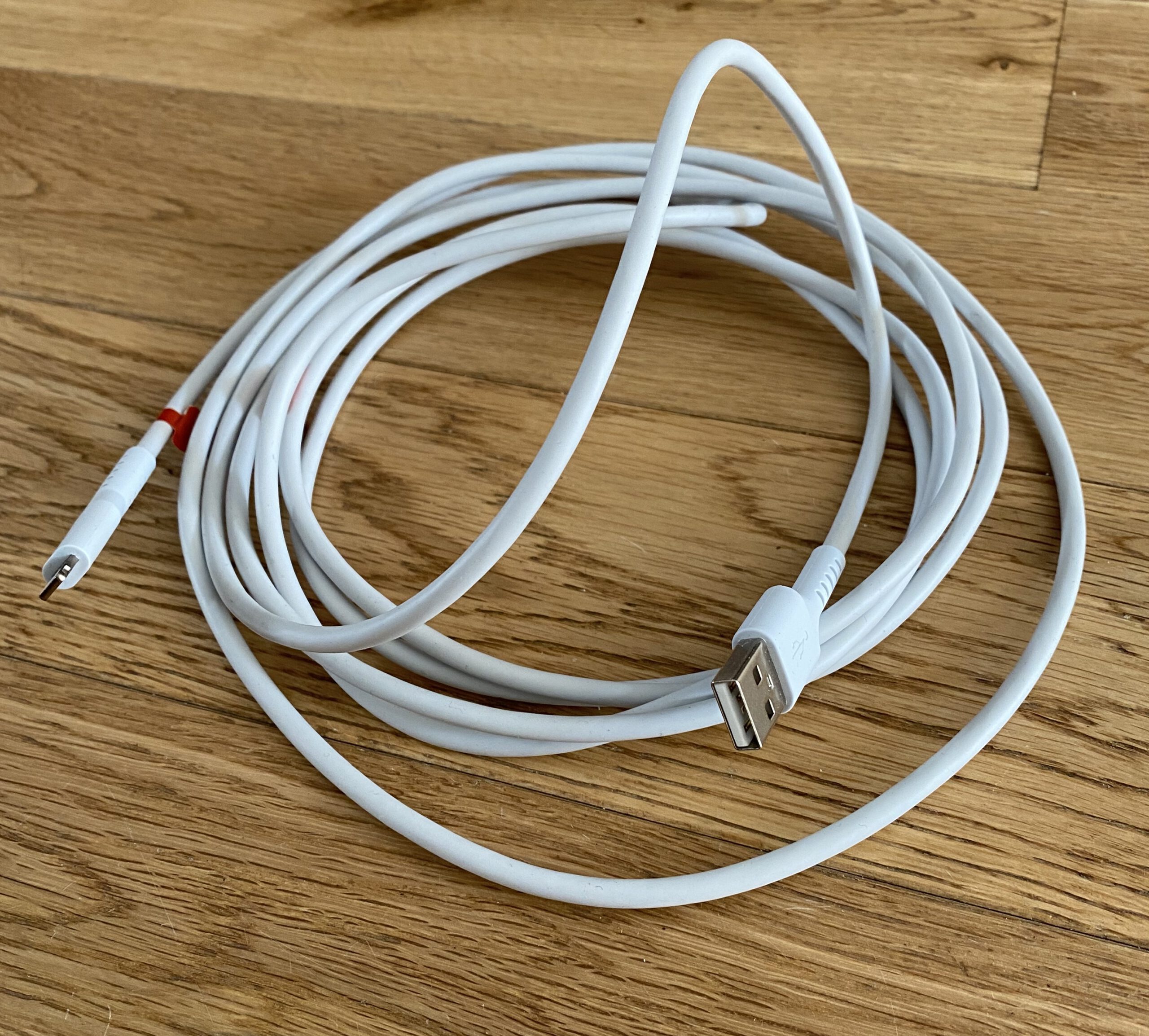
Something as unrelated as a cable can become a snake preparing to strike, or a tangle of pasta, or …
You get the idea. Once you’ve got your mind moving, it’s not hard to change gear, or change track, and concentrate on what you were working on before that block stopped you. Block? What block? Is it a baby block with letters on it? Or a line of traffic cones? Or somebody in front of you waving a flag, or fallen tree, or an abandoned car in the middle of the street?
Whatever it is, it’s behind you now.
Relentless
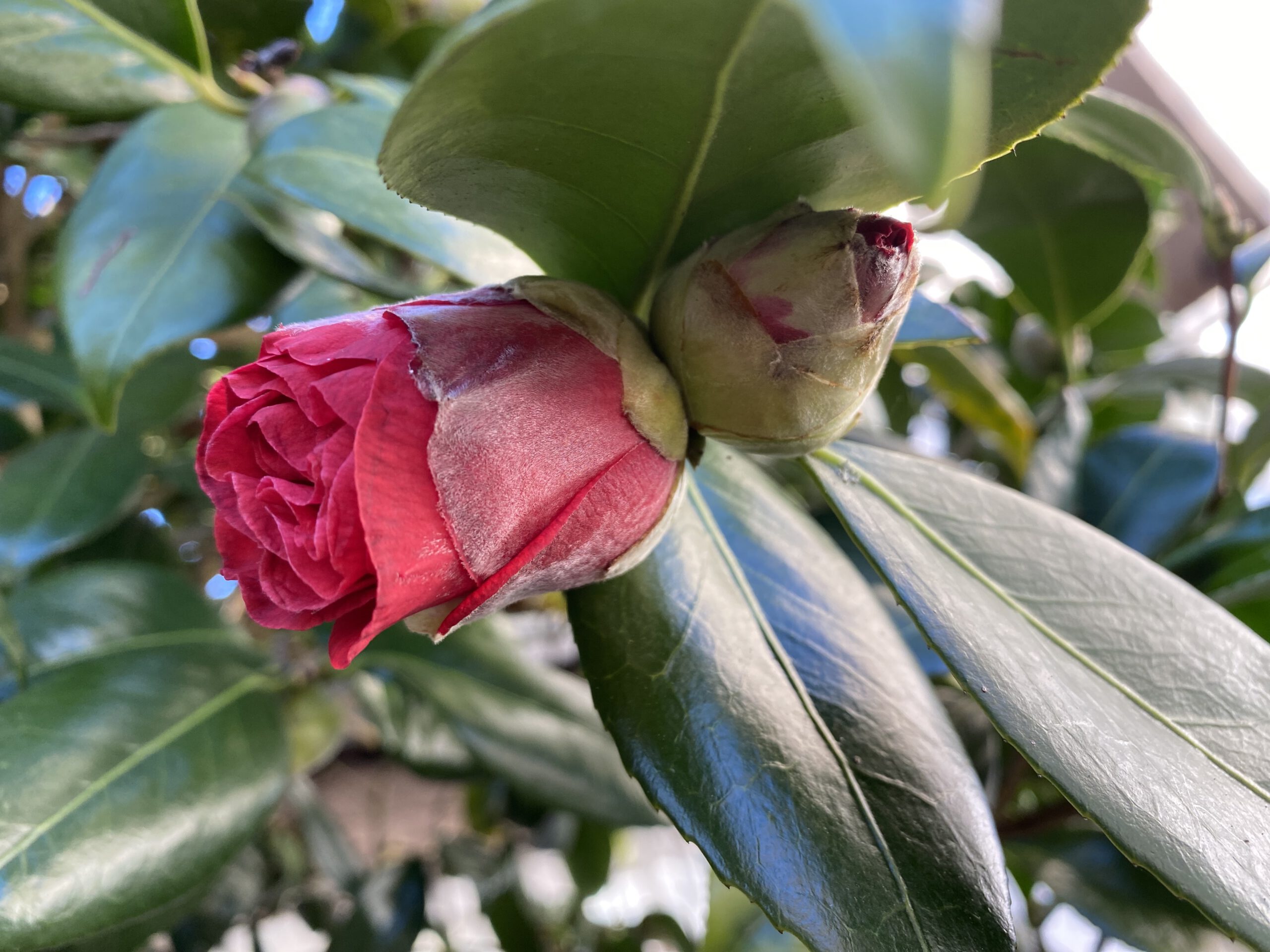
Camellia bud primed for bursting
Even if it seems like it will never end, winter doesn’t last forever. The first harbingers of spring still arrive with a very welcome sense of regularity
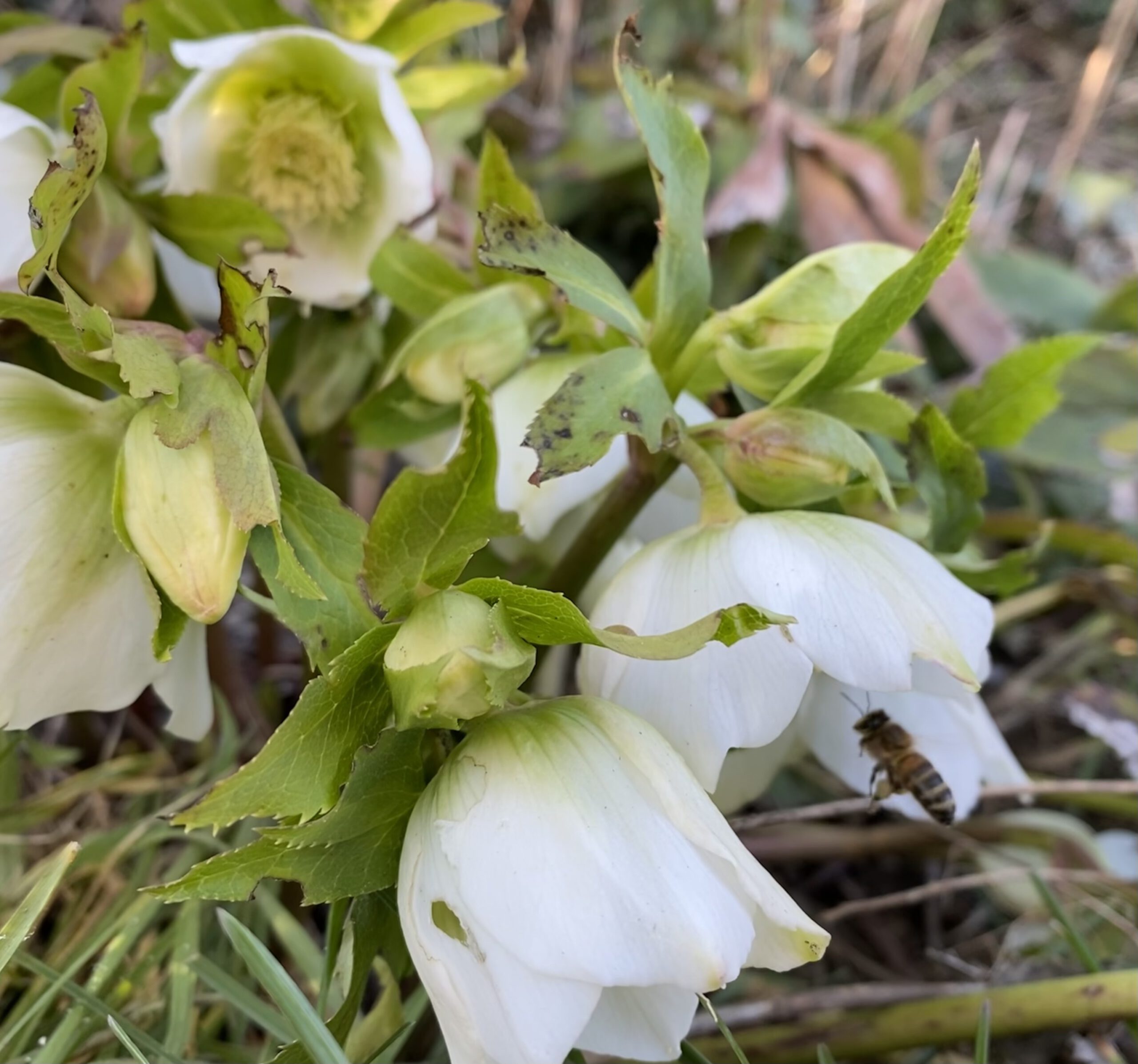
An early bee goes looking for lunch
I was cradling a cup of tea in my hands, letting the heat penetrate into them, when I couldn’t ignore that background noise any longer. Was someone driving a flock of geese up the narrow lane which, when it’s on duty, doubles as the high street of the village?
I opened the door, looked up and down, there was no life form of any kind to be seen. Unless you want to count the skeletons of weeds along the side of the road – frozen, dried out and left for dead by a merciless winter. Glancing down the intersection, there was evidence of life: three humans, all facing skywards. I followed their gaze and saw … the pale, late-afternoon winter sky filled – and when I say filled, I mean filled – with migrating birds. They were flying in V-formation, and as high up as they were, their screeching and honking filled the air as though they were padding up and down the high street, looking for trouble.
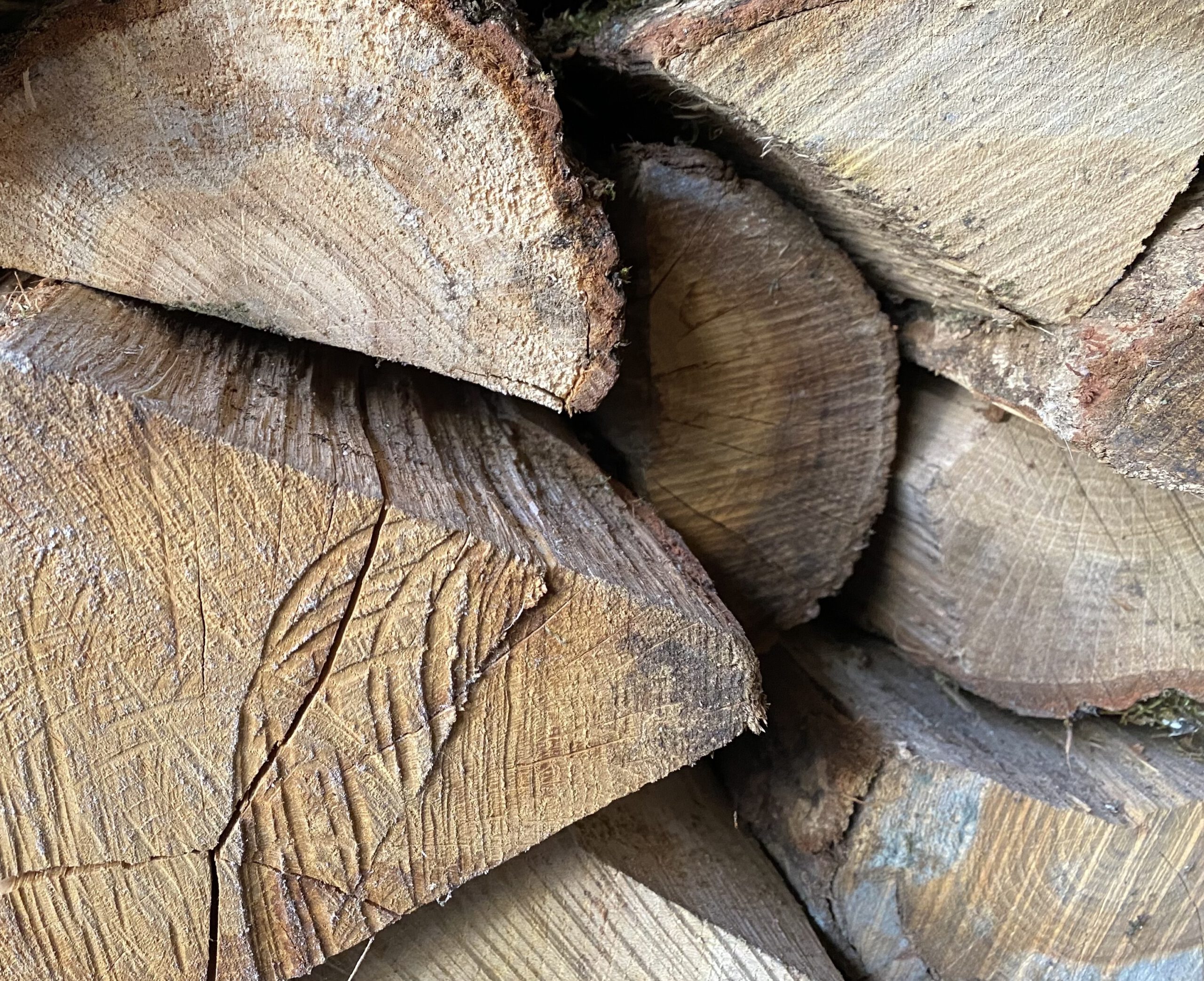 That morning we had just been stacking another delivery of firewood. Without any other effective way of heating the house we, like almost everyone else here, still spark up the reliable wood stove, which magically fills the home with warmth and the air with its caramelly, spicey perfume. The logs clunked one after the other on the pile made a xylophone music of their own.
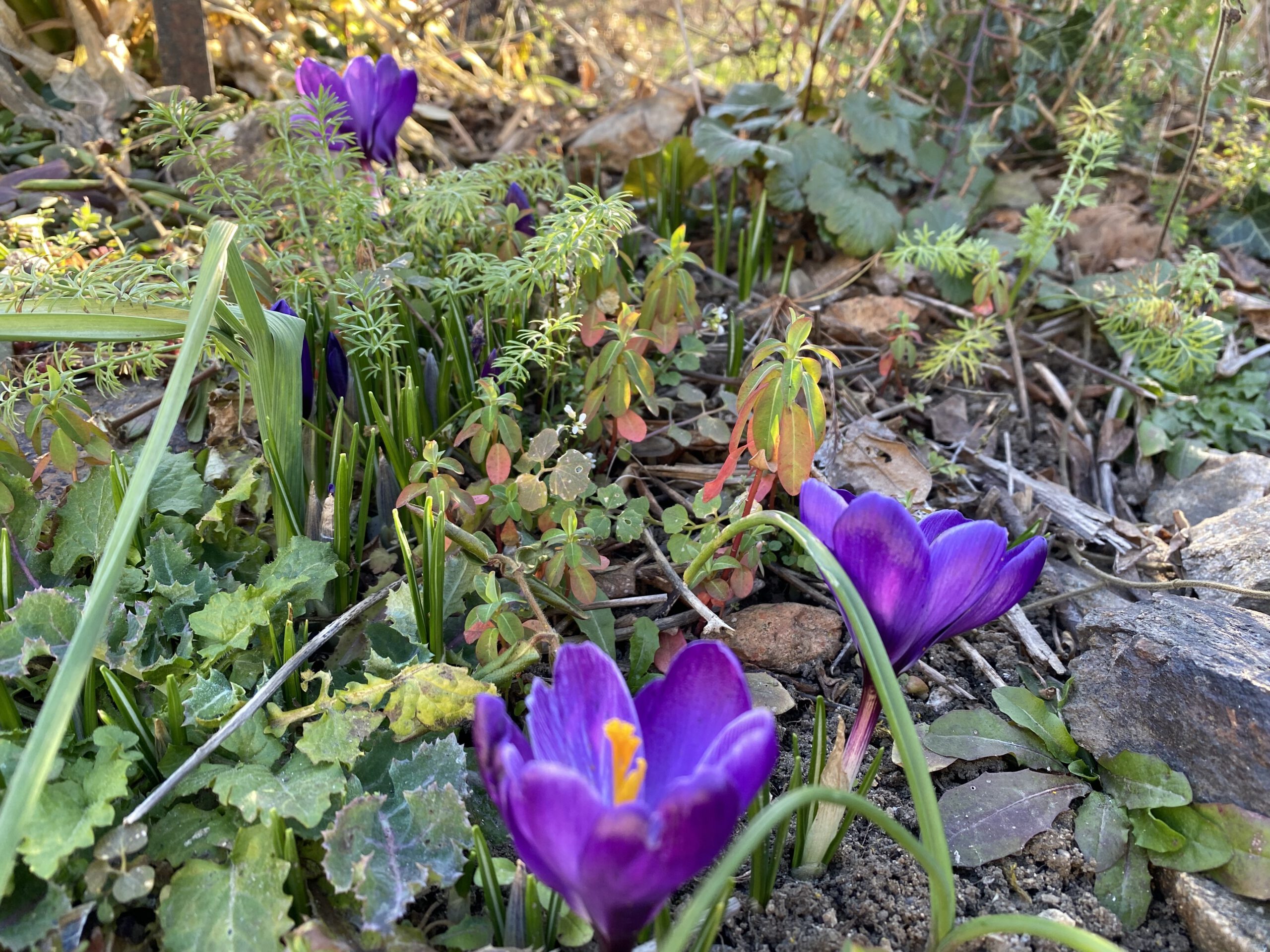
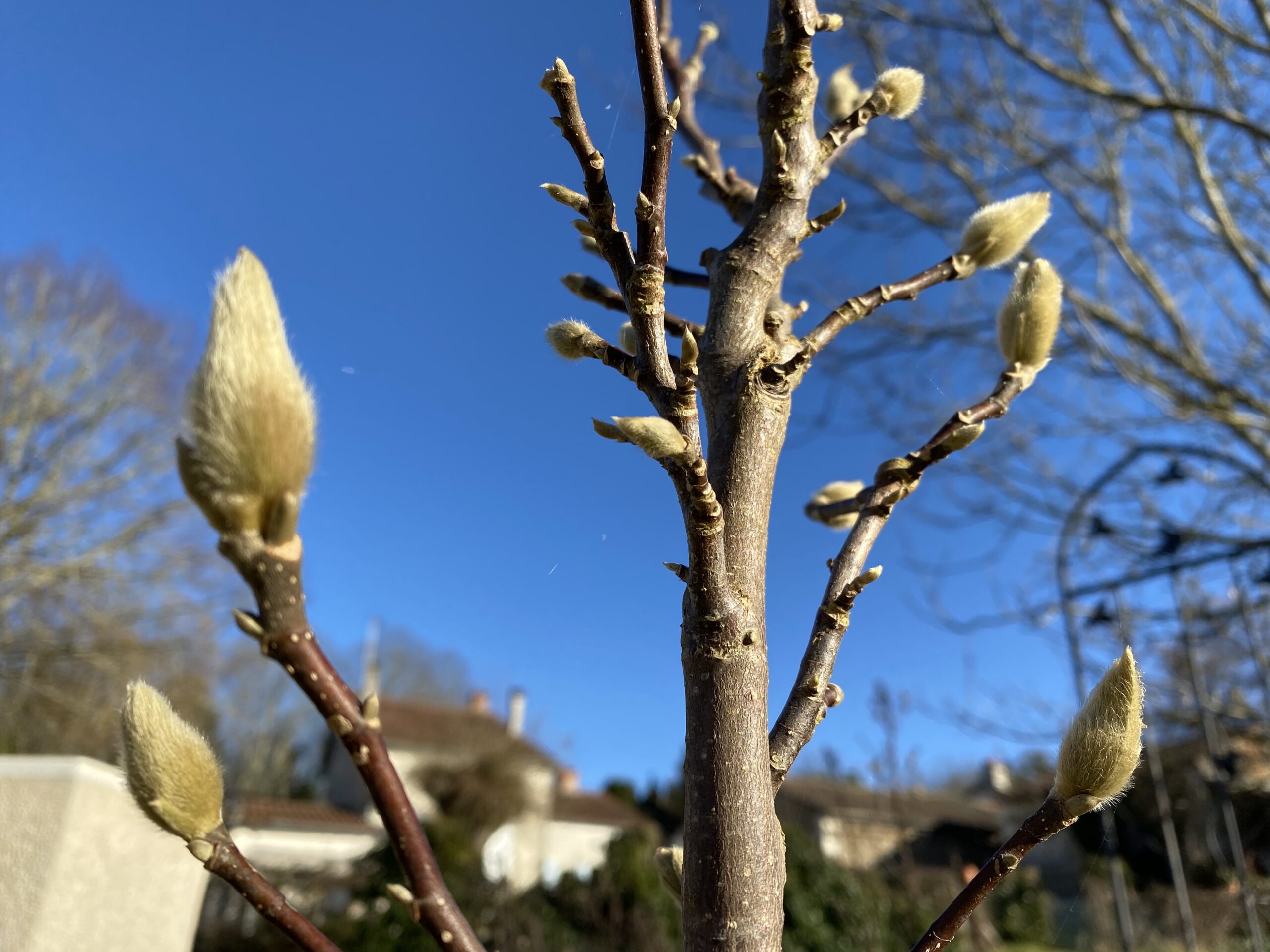
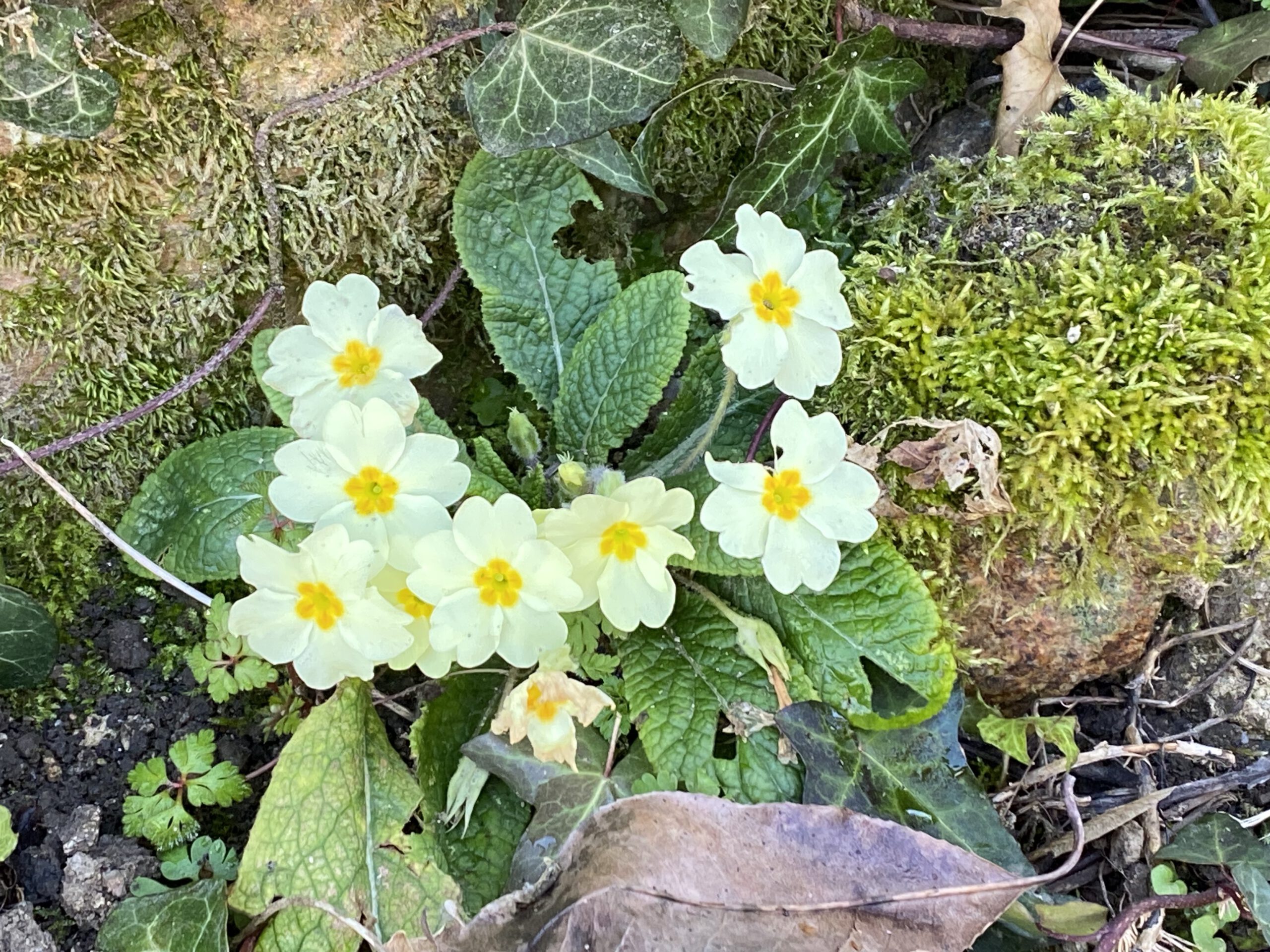
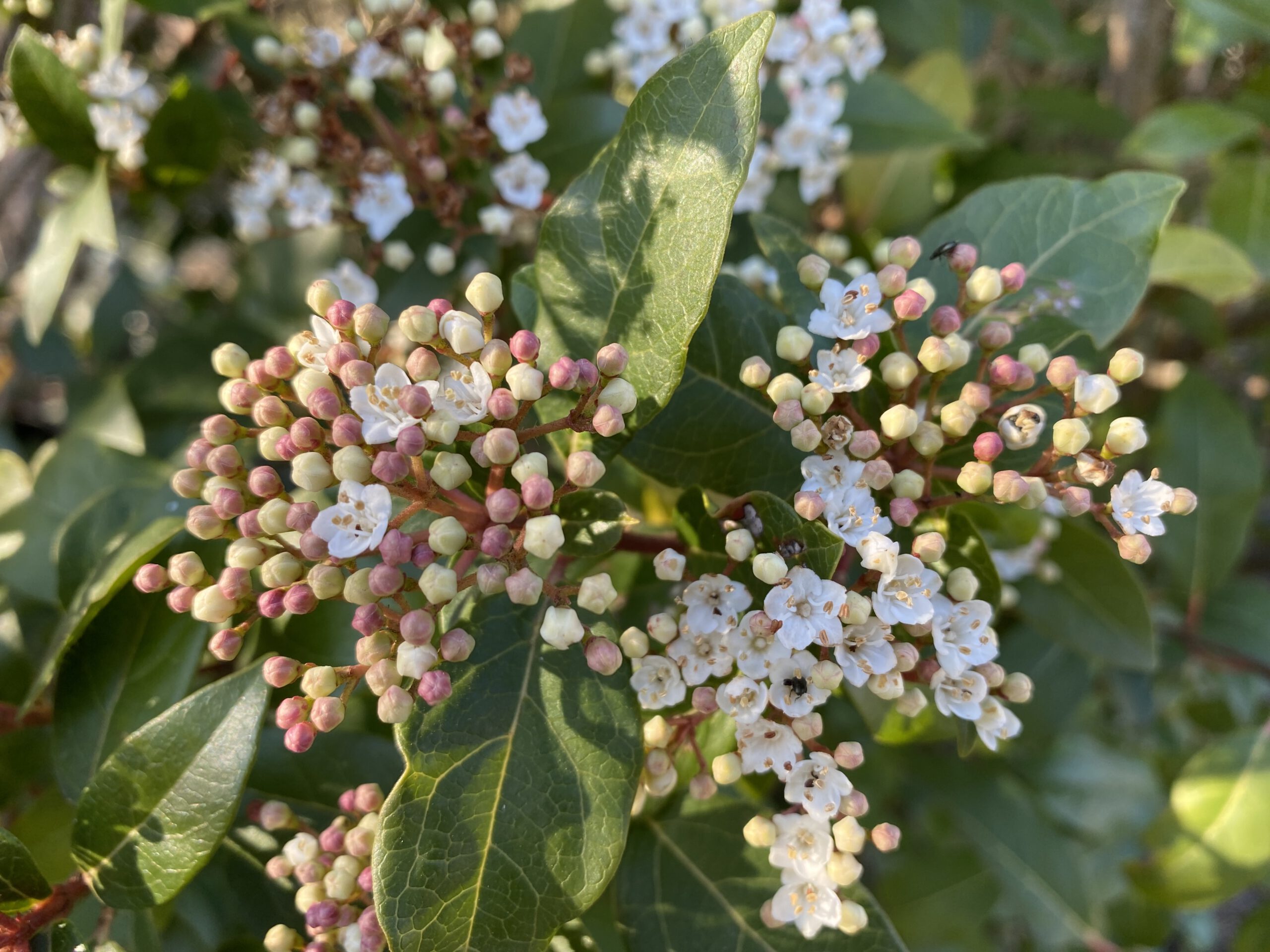 Yet winter is obviously beginning to weaken its frozen hold on the landscape. The air is no longer dry and biting but smells of leaf mould and damp soil in the mornings. The sound vacuum has been breached by a hundred different melodies of birdsong. Plant life, while still not at its vigorous, verdant best, looks fuller, plumper, gathering strength for an imminent profusion of green and colour. Buds swell on stems, on shoots, on green protrusions everywhere – some green, some silvery, some already a sassy shade of pink.
 And those birds. They were cranes, I was told by Miguel, the Portuguese potter and general savant who lives down the other road leading down, then up the hill and out of the village. There were thousands of them, squawking as they flew from south to north, in V-formations that undulated sinuously across the sky. Occasionally an individual bird here and there would detach itself from one V, then join another, no longer distinguishable from any of the others. For some 20 minutes, these birds, pointing like arrows forming bigger arrows towards their secret destination in the north, kept coming from one horizon, to disappear into the opposite one. Always with the same unerring, unveering, relentless sense of purpose. How they know what to do, where to go, when to depart, and how to arrange themselves – in fact, why the V-formation? A good question for Google. Or, rather, the very aptly-named search engine Duck Duck Go.
 But that is for another day. At the moment, I’m just enjoying being filled with the sense of awe at the immensity of it all, the sense of imminent, momentous change. And soon not having to warm my hands on too-rapidly cooling cups of tea.
Fan fiction
Can a third-generation Bertie Wooster get out of his impending marriage to Penny Dreadful? Only Jeeves, great-great-nephew of the original famous Jeeves, can save the day
THERE WAS NO TIME TO LOSE. “Jeeves!” I called out. “Jeeves!”
“Sir?” He was in the front sitting room. I burst through the door like an express train being chased by rocket in an angry mood. I mean, I’d never seen an express train burst through a door, but I was in one once. If something could burst through the door like Bertram Wooster III did just now, it would be an express train in fear of its life. I imagine steam was even coming out of my ears.
“Jeeves!”
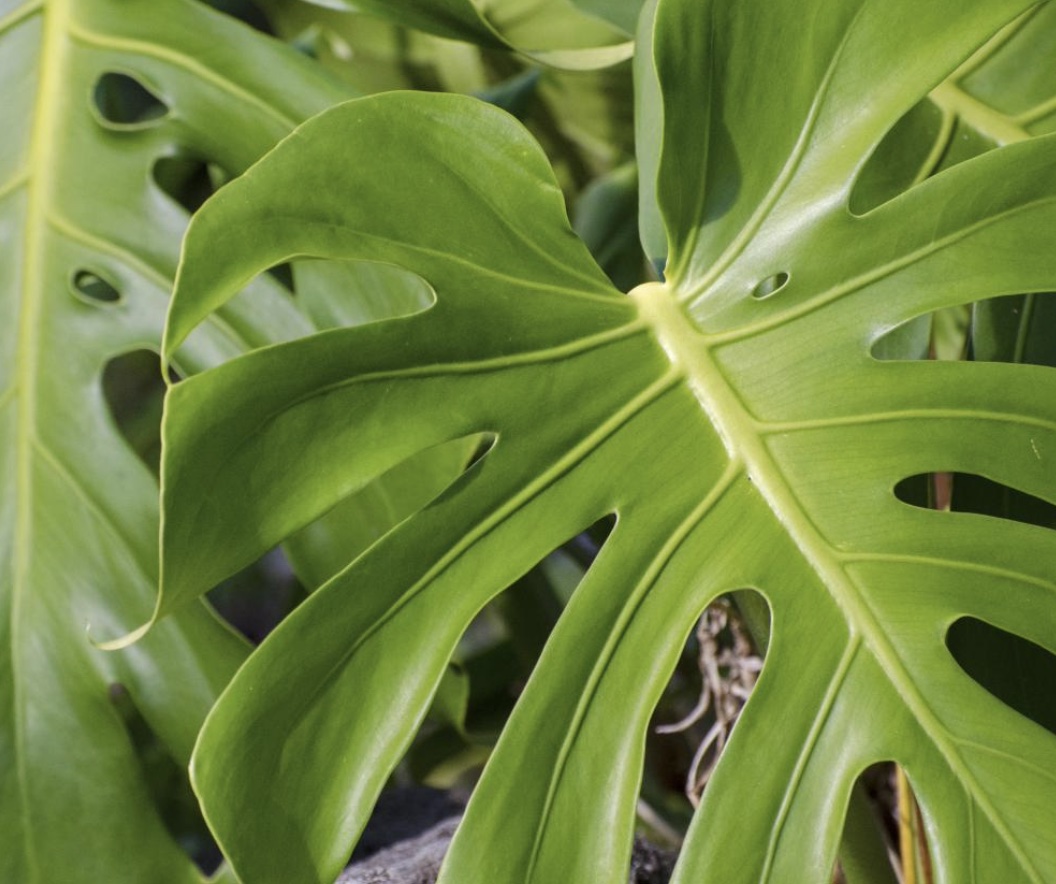
“Yes, Sir?” My man Jeeves was, as ever, as cool as a slice of cucumber in a freshly-made glass of Pims. He was busy, standing on a stepladder and calmly adjusting a philodendron in the corner.
“Jeeves!” I said. “This is no time to be fraternising with foliage!”
“Sir?” He climbed down from the ladder and came to face me.
“We’ve got a devil of a crisis!”
“Indeed, Sir?” said Jeeves. He glanced back in the corner at the philodendron as though, in a housefire, it would be the first thing he would protect. Sherlock Holmes said that once, and I’ve no doubt he was right on the money. I mean, that in case of fire the first thing you glance at is your baby, or something like that. Baby being a metaphor for the philodendron you might like to save.
“This is no time to be worrying over houseplants, Jeeves! We’ve got a crisis on our hands!”
“Indeed, Sir?”
Really, the man could sometimes be infuriating. If I didn’t know he had the brainpower of a supercomputer, I’d think the man was a bit dim. But, like his great-great-uncle Jeeves, who used to be the valet of my great-great-grandfather Bertram Wooster – the first, although his parents didn’t know it at the time they named him – he had oodles of the grey stuff between the ears. Much more than most people would know what to do with.
“Pay attention, Jeeves! I need your help. Otherwise, I’ll find myself walking down the aisle with Penny Dreadful!”
“Miss Penelope Purbright? I was not aware there was such a closeness, Sir.”
“Nor was I, Jeeves. But she seems to think I have proposed tying the knot.”
‘Dearest Bertie, I’d love to go down the aisle with you! Your love-bunny, Penny’
“And this was not your intention, Sir?”
“Indeed not! I was just tootling out of the Drones Club, thinking how jolly it would be to get another jar or two into me before returning home for a bracing whiskey and soda and the sleep of the innocent. So I sent old Pongo a test message, asking him to come down for an ale.”
“And did Mr Pendragon involve you somehow with Miss Purbright, Sir?”
“No, the bally Mr Pongo never showed up! So I had my pint of ale and came home for the evening ritual as usual. But I’ve just woken up to see this message: ‘Dearest Bertie, I’d love to go down the aisle with you! Yes, let’s get married, the sooner the better. Your one and only love-bunny Penny’.”
“Most disturbing, Sir.”
“She must have intercepted my text message to Pongo, and read it wrong or something.”
Jeeves glanced back at his old pal the philodendron, making sure it was still there and hadn’t fainted from shock. Then he turned back to me. “Strange things do happen, Sir. If I might be so bold as to to ask to have a look at your mobile phone?”
‘Jeeves, this is no time to be making eyes at potted plants!’
“Do, Jeeves, and have it sent back off to the company or Elon Musk or wherever it came from. There’s something wrong with it.”
He took the thing off me gingerly like it was a dead but particularly interesting-looking newt and stared at the screen. Then he looked back around at the philodendron and raised an eyebrow at it.
“Jeeves, this is no time to be making eyes at potted plants!”
“No, indeed. If you’ll permit me, Sir, I notice that there seems to have been a miscommunication. Your text message was mispelt, no doubt due to the peculiarities of the autocorrect function. It asks the recipient to come down the aisle with you. And perhaps for the same reason it was mistakenly sent not to Mr Pendragon but to Miss Purbright, who thought you wished to lead her down the church aisle to matrimony.”
“Gosh, Jeeves, what am I going to do?”
Dashed if my man Jeeves didn’t turn around and look at that philodendron again like he expected to find an answer hanging there like ripe fruit.
“What are you staring at?” I roared at Jeeves. I looked at the plant. There was nothing particularly notable about the damned thing. It was green and tall, just like a philodendron should be, if it plays its cards right.
“If you’ll permit me to explain, Sir,” Jeeves said, and then did a rummy thing. He stared back at the plant, raised that eyebrow again, and said to it: “I think it’s time, don’t you?”
“Time? Time for what? I’m the one with the problem, not the bally plant!” I shouted. “I don’t imagine it would mind being eternally bonded to Penny Dreadful. I mean, she’d probably water it with vodka, but maybe that would be a welcome change for it.”
‘“Have you indeed?” And I meant it to sting’
“If you’ll take a closer look, Sir, you’ll see that here, just under this upper leaf, there is a small video camera. I have for some time been filming our interactions, as I believe they are of significant educational benefit for the greater masses. So our conversations and problem-solving encounters are being streamed straight to the TikTok video application and watched in real time by millions of the deserving public, eager for instruction.”
I was dumbstruck. I mean, what? What? And I retorted in no uncertain terms: “I mean … I say … what? What?”
“I have for some time been quite sure that you would find this practice entertaining and profitable.”
“Oh, have you, Jeeves? Have you indeed?” And I meant it to sting.
“I should mention that you have now become an international TikTok star. I – we – have millions of followers, Sir. Fans who are keen to watch and learn. This also means that I – we – have attracted a great volume of sponsorship.”
“What the bally heck are you babbling about, Jeeves?”
“Your internet stardom has attracted the attention of purveyors of many luxury goods, who would be very happy to offer you a gift or the use of their products if you would care to demonstrate them in your video channel. You have, Sir, become an Influencer.”
“What are you drivelling about?” I said, then paused, as what Jeeves said entered the old grey matter and sank in. “What luxury goods?”
“Just this morning, Sir, I received a request from a representative at Maserati car manufacturers. They were very intent upon offering you the use of a vehicle from their house for a limited amount of time.”
“How limited?”
“They suggested a month, but I convinced them that nothing under a year would be acceptable to a gentleman of your standing.”
I thought about this. I mean, sometimes Jeeves gets a bit too big for his breeches and oversteps the boundaries of valet something or other, valet-ness. On the other hand, his big brain does get me out of the odd scrape that fate dishes up.
“But what about this marriage with Penny Dreadful?”
Jeeves gave a gentle cough.
I believe that it has already been cancelled, Sir. This episode is still currently streaming and … ”
My mobile phone pinged with a text message.
“If I’m not much mistaken, that will be Miss Purbright now, retracting her acceptance. You see, this episode – interlude – has already been streamed to your millions of fans. No doubt Miss Purbright … ”Jeeves glanced down at the screen. “Yes, she has done it. Shall I read it out to you, Sir?”
‘The hashtag #PennyDreadful is now number 2 in the trending list’
“Certainly not! I’ll take your word for it. Just delete the whole thing. Delete her from the phone entirely.”
“I’m afraid I can’t delete her entirely, Sir. She is one of your three million followers.”
“Even though she now knows that I call her Penny Dreadful?”
Jeeves coughed delicately and handed the phone back to me. “The hashtag search term #PennyDreadful is now number two in the trending list. And I believe she has just changed the name of her Twitter identity to match that epithet.”
“But she still doesn’t want to marry me?”
“No, Sir.”
“A narrow escape, Jeeves.”
“Indeed, Sir.”
I peered up into the philodendron. It wasn’t such a bad old plant, really. “Will Maserati throw in some leather motoring gloves and goggles?”
“I’m sure they can be prevailed upon to provide them.”
“Well, sign us up, then! When can they deliver?”
“I believe the car is waiting for you outside the front door, Sir.”
What can I say? “Jeeves,” I said, “you’re one in a million.” I turned to Philly the Philodendron. “One in a million!” I repeated.
Jeeves turned to the plant as well, and a corner of his mouth just flickered, but then maybe I was imagining it. He looked back at me. “Thank you, Sir. I aim to give satisfaction.”
• A version of this story first appeared in the anglophone German magazine Spotlight in October 2020