
Oh holy night
“NAME?”
“Dennis. Dennis Mobray.”
“Age?”
“Six.”
The woman at the desk looked up at him over her glasses. “OK. Slightly bolshy sense of humour. I’ll make a note of that in the character profile. A lot of people don’t like that. But some families do, actually.” She scribbled something lower down on the page. “So, let’s start again. Age?”
“Thirty-six.”
“Thank you. Now, your original family configuration.”
“Is that really relevant?”
“Dennis,” the woman sighed. “We are trying to achieve the best fit possible for you and your host family. Of course the makeup of your original family is relevant in order to assure the success of your holiday visit.”
“But, Shirley,” he started.
‘Christmas was torture. I just want to watch boxsets on TV’
“I’m sorry, my name isn’t Shirley.”
“But the nameplate – ”
“This isn’t my desk. I’m filling in while Ms Nott is away.”
“Oh, right. Sorry. My appointment was with Shirley Nott. Anyway, what I wanted to say was that I don’t want to spend Christmas with anybody. I hated my family. Really, I hated them. Christmas was torture every year. So I don’t want to go anywhere. I just want to sit in front of my TV and watch box sets. Is that so bad?”
The woman sighed again and put down her pencil. “Dennis,” she said, “I understand your anxiety about the situation, but really, there’s no cause for concern. Since the government decided to do something about the increase in suicide during the holiday period by ensuring that everyone had a family to go to, it’s out job to ensure that everyone is paired with just the right family for them. So, if you’ll just co-operate now, we’ll do everything in our power to make your holiday period a happy one.”
“But…” Dennis struggled. “I’m sorry, what is your name then?”
She looked back down at the files on her desk and continued to go through them. “Holly Green.”
Dennis flinched, but continued. “Thanks, Holly. It’s like this. I just don’t want to be with anyone on Christmas Day.”
“Of course you do,” said Holly as she finished with one file and began to study the next. “Everyone wants to be with someone at Christmas. So, let’s see… “I’ve a nice family here, just perfect for you. It’s a lovely elderly couple with two adult children, both with spouses of their own, and the son has two sons of his own who just love to play football. You can all go outside and kick the ball about while gran and the women prepare the meal. The grandad got a replacement hip recently, so he just stays quiet in front of the telly watching the Queen’s speech and Dad’s Army and drinking cider.”
“Isn’t that a bit sexist? That’s exactly what contributed to my mother dying so young.”
‘He doesn’t swear quite as much, will have the four children, his mum, auntie and cats’
“Oh, dear, didn’t I tell you to explain your family circumstances? Let’s try another… Ah, here’s one. Not the same ages, but the father is a foodie, a big Gordon Ramsay fan, so he’ll be preparing a holiday meal special. It does says here he doesn’t swear quite as much as he used to, you’ll be glad to hear. He’s divorced, so I’m afraid his wife won’t be there, but he’ll have the four children, ages three to 12, his mum and his auntie. You don’t mind cats, do you?”
Dennis slapped his hands on the table. “Listen, this is ridiculous. I don’t want to spend the holidays with any family. Nobody. Not even the Holy Family. Do you understand?”
“I’m sorry, Dennis, but there’s nothing I can do. It’s regulation. So let me see if I can find another home for you … ”
“No, Holly, that’s it. I don’t want another family. Where is Shirley, anyway? Can I just again when she’s back?”
Holly sighed again. “I’m afraid that’s not possible, Dennis. She won’t be back in the office until after Christmas.”
“Oh,” said Dennis. “I’m sorry, is she ill?”
“No. Well, prevention, really. She does go a bit funny this time of year, so the doctors have recommended she travel somewhere where they don’t celebrate Christmas. So she’s in Jaipur until after New Year’s.”
“Oh, good God,” Dennis groaned.
“Oh, that’s just given me the most wonderful idea!” said Holly. “You can go to her family. Her parents have just got back together again and her brother will be on parole starting next week. They’ve actually requested someone open and friendly …”
Dennis stared at her, open-mouthed, as she got out the file. “It says here … oh, by the way, do you know how to disarm someone with a knife?”
A version of this story originally appeared in the German magazine Spotlight
All aboard

Actors Karen McCartney, Lisa Lambe and Sophie Jo Wasson in Connolly Station, Dublin. Photo: Ros Kavanagh
A new musical theatre piece takes a trip to the past on Irish feminists’ Contraceptive Train
GREAT to be in Dublin again during the festival season. During the five-odd weeks of the Fringe and Dublin Theatre Festival in September/October, Dublin city is a magic place. An invitation to be a participant in a panel discussion, Found in Translation, had me once again strolling the streets of city centre in the early evening twilight, enjoying the atmosphere – somehow both easy-going and fizzing with excitement, as only Dublin can do.
The timing was just right to see a new show by my former colleagues at Rough Magic: The Train. Just a decade after his fabulous Improbable Frequency – about a treacherous, but very improbable collusion between espionage and physics during the “Emergency” (the Irish expression for the second world war) – playwright Arthur Riordan turned his genius rhyming wit to another historical event: the Contraceptive Train.
In 1971, when Irish feminists were looking for a new stunt after their headline-making protest in front of Mansion House (the residence of Dublin’s Lord Mayor), they came up with the scheme to flout the ban on birth control in Ireland by taking the train to Belfast and tooling themselves up with contraceptives. They planned to bring back the Pill, coils, diaphragms, whatever they could get their hands on, and enter the Republic, where contraception was still illegal.
The train on 27 May 1971 carried 47 members of the Irish Women’s Liberation Movement, who arranged to meet at a certain chemists for the big purchase. Unfortunately, living in a country where contraception was illegal meant that information on contraception was also thin on the ground, and the women were dismayed to find out you needed a prescription for anything other than condoms or spermicidal jelly. Ingenuity saved the day, though. As well as the jelly, they bought aspirin, reasoning that the customs officials in Dublin’s Connolly Station would never know the difference.
They thought they might well get arrested when they disembarked with their loot. Instead, hundreds of people welcomed them with placards, shouting, “Let them through! Let them through!” The women marched up defiantly with their contraband contraceptives – some swallowing their “pill”, some flaunting their jelly – and the duty officers were pink with embarrassment. It was a blow struck for women’s rights and their freedom and control over their bodies and lives.
Contraceptives only became legally available in Ireland in 1980 – due in great part to barrister Mary Robinson’s strident campaign for legalisation. (In 1971, Robinson was a Senator; she became the first woman president of the Republic of Ireland in 1990, and took office as UN High Commissioner for Human Rights in 1992.) The battle still wages over abortion, with many campaigners, including Amnesty International, pushing to change the law and have it decriminalised. Thousands of women domiciled in Ireland currently travel to the UK for terminations every year rather than face a 14-year prison sentence.
Homing in on the housing shortage
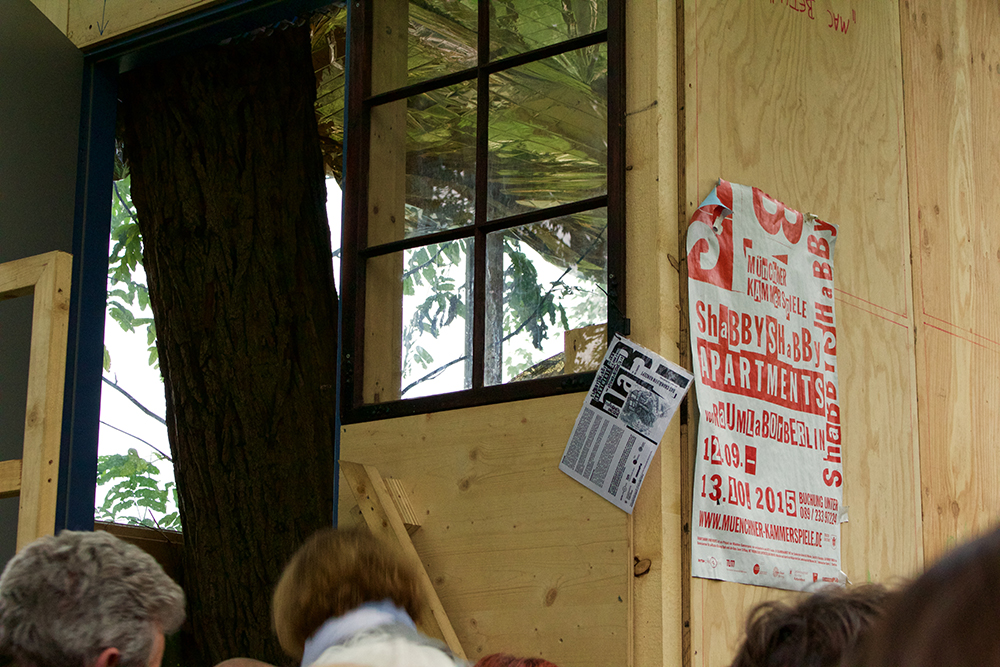 WE’VE all experienced the desperation of trying to find accommodation in a new city. When places are barely big enough to fit the amount of money you’d need to rent them , it’s time for a rethink. Especially if you’re an arriving theatre director looking for a channel to vent your flat-hunting frustration.
Not sure if the new artistic director of the Münchner Kammerspiele, Matthias Lilienthal, has dossed in any of them, but the pre-premiere piece of his first year at the theatre has sprung up across Munich like mushrooms – sometimes looking a bit like mushrooms as well. The project, Shabby Shabby , points a finger at the dismal – and worsening – housing situation in many trendy cities.
The idea isn’t entirely original – Lilienthal presented it before at the Theater der Welt festival in Mannheim – but it feels pertinent and pressing in Munich, a wealthy city with a dire housing problem. Looking for accommodation here is like attending a casting call on Broadway, and a friend of mine swears she’s seen money quietly changing hands between desperate, hopeful tenants and a smug estate agents.
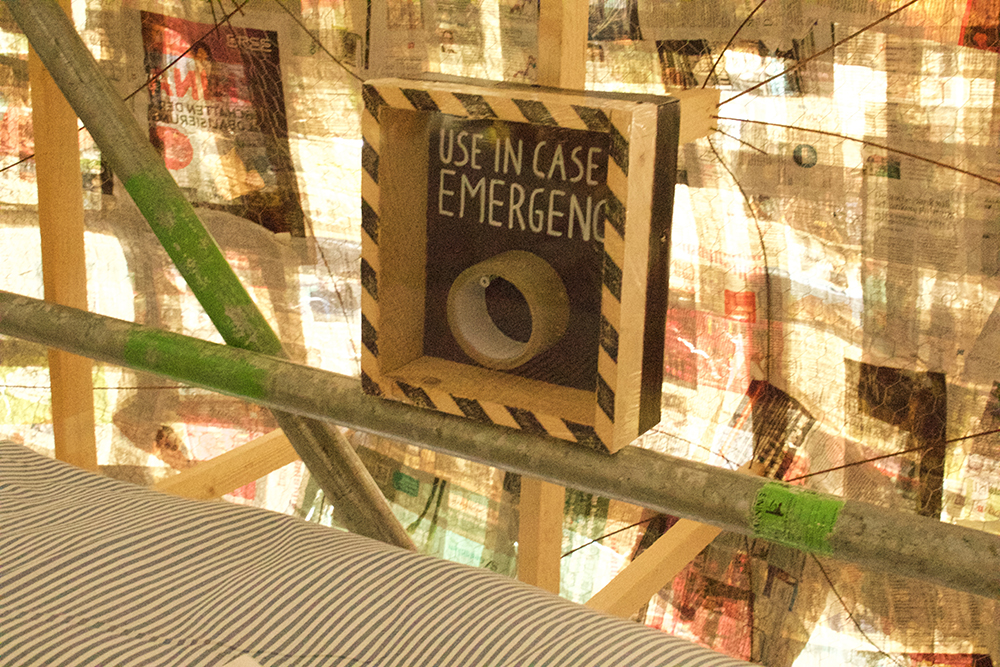
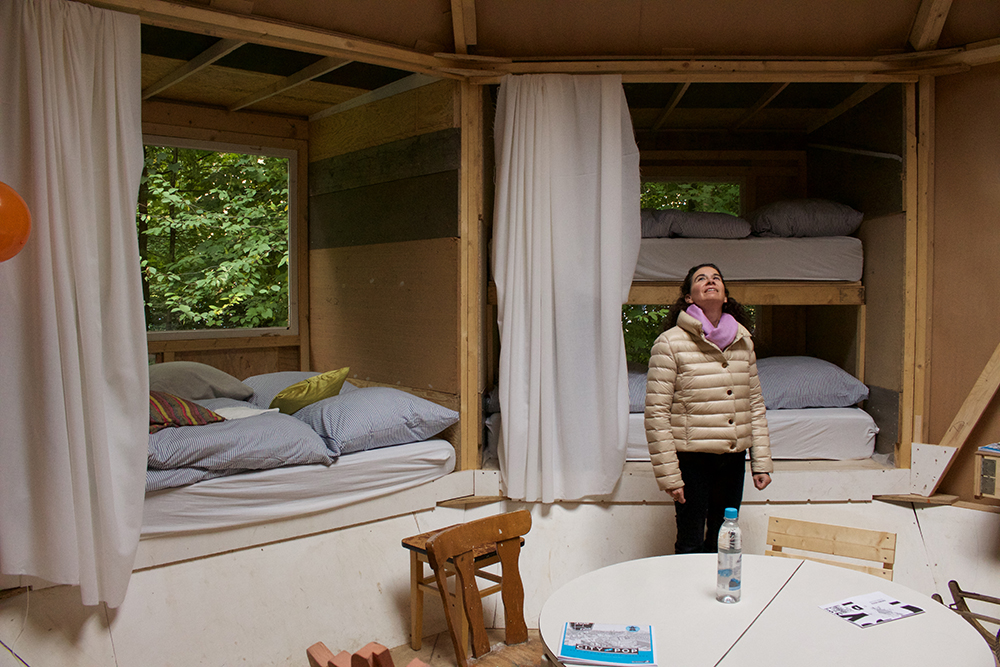
After receiving more than 250 designs from all over the world, the MK chose 23 to develop. The projects were built at various locations around the inner city, and people can book a night in any of them – with the unfortunate exception of one, called Yellow Submarine, that burned down, quite likely due to arson. As a result, they’ve stepped up security, and the remaining dwellings can be rented out until 13 October. If you’ve ever attempted to book a bed in Munich during the Oktoberfest, you’ll appreciate how useful extra shelter can be.
I took a tour of the Shabby Shabby apartments last weekend. Some were clearly cosier than others, but apart from being sturdy enough to spend the night in, they took camping to a new level, a bit like being able to bed down in a cross between a museum installation and a Druid dolmen.
The structures are only temporary – they need to be dismantled and taken down after the 13th. Do they highlight the need for more – and more affordable – housing in Munich? Do they project a sense of what it’s like to have to huddle in a doorway or under a bridge for warmth and shelter? The recent arrival of thousands of refugees amplifies the significance of having to sleep in makeshift – and torchable – accommodation. But most Shabby Shabby punters can go back to their cosy homes the next evening. Hopefully with a heightened awareness of how lucky it is to have a secure roof over your head, and how vital it is to find ways to provide the same for less fortunate members of society.
Best thing about it Reliving that tickle of excitement from childhood when you got to spend the night in a treehouse in your best mate’s back garden
Worst thing about it Obviously, the name – another example of English used in a German context to sound cool, and achieving the opposite.


The dark side
“OH GOD,” cried the man on the park bench, and buried his face in his hands. “God, what am I doing here? What’s the point? What does it all mean?”
The pinstripe-suited woman on the other side of the bench glanced at him out of the corner of her eye. Then she wrapped her sandwich, stood up and walked away briskly.
“God, why am I such a loser?” he moaned. “And now I’m even talking to myself.”
“Not entirely,” said a warm and friendly voice. The man looked back at the place where the woman was just sitting. Someone else had plonked himself down. A rather dapper looking man wearing a black leather jacket like his, black jeans like his and black trainers like his. Only the other man’s things looked new. And posh. Like they came from Hugo Boss. Not Lidl, like his.
“Em, do you mind?” said the first man. “I’m having a very private nervous breakdown here.”
“Don’t let me interrupt,” said the dapper, Hugo Boss man. “Only you’re why I’m here.”
“Look mate, I’m not your type. Go hit on someone at the Four Seasons bar.”
“No, I think you’re exactly my type. I’ve been waiting for you for a while.”
‘I deal in the strongest drug of all’
The man looked at Hugo Boss man. Calling the police was not an option. He got up.
“Ah, you don’t want to leave just yet,” said dapper man.
“What do you want?” said Lidl man, suspicious.
“You.” Dapper man smiled. It was an oily smile.
“I told you, I’m not your type.”
“Oh, but you are. You see – sit down,” dapper man said as the other man reconsidered and prepared to make a break for it. “I won’t beat about the bush. I’m Mephistopheles, and I’ve – ”
“You’re messin’ with me?”
“Mephistopheles. Old Nick. I’ve come to help you achieve your wildest dreams.”
“Fuck off.”
“No, really. I can get you anything you want.”
“How about some coke?”
Mephistopheles – formerly dapper man – pulled a small plastic bag out of his smart leather jacket and held it out to his new friend.
“Well, em,” said the first man, pocketing the bag, “actually, I meant Coke. Like in the can? I’m dying of thirst.”
“Don’t go dying on me just yet. We have to seal our bargain first.”
“No bargains.”
Mephistopheles snapped his fingers, then bought a can of Coke from a vendor who instantly walked by them on the path.
“Wouldn’t you like the power to summon everything you want to yourself at any moment? For the rest of your life?”
“Are you a dealer?” asked the first man.
“Of a kind. I deal in the strongest drug of all.”
“Meths? Plutonium?”
“Those are human drugs.”
“Oh, and yours are from Mars, are they?”
“I told you, I’m Mephistopheles. My drug is the human soul. You’re not using yours, and I could certainly make use of it, so how about it? Do we have a deal?”
The first man stared at him, and took a sip of his Coke. “So, you could get me clothes like yours?”
“Better,” grinned Mephistopheles. “Take a look at yourself.”
The first man looked, and widened his eyes. He was now wearing the finest leather, the smartest jeans, the coolest trainers money could buy. Except he hadn’t bought them.
‘That’s like Mary Poppins’s fuckin’ carpet bag’
“Shite!” He took another swig of Coke. “How about a whiskey?”
Mephistopheles pulled a bottle of aged single malt out of his jacket.
“That jacket is like Mary Poppins’s fuckin’ carpet bag.”
“Good old Mary,” said Mephistopheles. “We dated for a while. Then I dumped her for Margaret Thatcher.”
“Sweet,” said the first man.
“So, do we have a deal, Johann?” said Mephistopheles.
“Who?”
“Do we have a deal, Johann?”
“Sorry, my name’s not Owen,” said the first man.
“Yes it is. Johann Faust.”
“No, I’m Nigel. Nigel McPartland. Or Nidge. And Feckface. But at least that’s better than, what was it? Owen Faust? Loser name.”
“But what are you doing here? I’m supposed to encounter Johann Faust on this bench. I’ve been waiting for… well, for ages,” spluttered Mephistopheles, who no longer looked so dapper.
Nidge reached into his new jacket. “Right, it’s still here. This the lad you’re looking for?” He pulled a credit card out of the wallet he retrieved and showed it to Mephistopheles.
“Yes, that’s him. What are you doing with his wallet?”
“I flattened the fucker and stole his car. I was just feeling bad about it when you turned up. I thought you were the fuzz. Nice to see you’re not, though.”
Mephistopheles stroked his chin thoughtfully, and a dapper pointy beard appeared on it beneath his fingers. “Hmmmm.”
“So, deal still on?” asked Nidge. He spat into the palm of his right hand and held it out.
Mephistopheles looked at him. Then he grinned, spat in his hand and grasped Nidge’s. “I think this will turn out just fine,” he said.
A version of this story originally appeared in the German magazine Spotlight
Lola Montez: a superstar ‘not even Madonna can reach’
 ONCE upon a time a fine, spirited wee girl was born to her Irish mother and Scottish father in 1821 in Grange, Co Sligo. Or perhaps she was placed in the cradle by the fairies, because little Eliza Rosanna Gilbert grew up to change her name and nationality several times and travel the four corners of the world in search of excitement and adventure. When she died, at the early age of 40, the world knew her better as Lola Montez, the Spanish dancer. As such, apart from gaining notoriety in Europe, Asia, Australia and North America, she became a countess in the central European country of Bavaria, started a revolution there and toppled its government three times.
“Next to Queen Victoria, Lola was the most famous woman in the world,” asserts German director Jürgen Kuttner, whose new production – with co-director Tom Kühnel – of the musical Lola Montez, by Peter Kreuder and Maurus Pacher, has just premiered at the Cuvilliés Theatre in Munich, Germany. “She was a superstar not even someone like Madonna could reach.”
Already a legend during her lifetime, Lola thrust herself into a whirlwind of adventure, excess and scandal that would make a society reporter blush. At 16, Gilbert eloped with a British lieutenant, but the couple separated shortly thereafter. She relaunched herself under her new identity as Spanish dancer Lola Montez and travelled across Europe, trailing scandals in her wake. In 1846, she arrived in Munich, the capital of the kingdom of Bavaria (now a state in the Federal Republic of Germany).
She sought an audience with King Ludwig I and, when he asked if her chest dimensions were real, ripped open her bodice to prove it. The 60-year-old king became besotted with her. He had her portrait painted and placed in his “Gallery of Beauty”. When Lola, reviled by the populace and government alike, wished for more power and acceptance, Ludwig made her first a Bavarian citizen, then the Countess of Landsfeld, an imaginary place. To accommodate her wishes, he dissolved and reformed his government twice. Ludwig presented her with a palace in a chic city-centre location and showered her with money. But rather than keep her head down to avoid further antagonizing an irate and begrudging population, she wore black and smoked openly in the streets – both taboos – while walking her enormous Great Dane.
Eventually finding herself at the centre of public hostility and warring student fraternities, Lola convinced King Ludwig to close Munich’s university. The tumult, fed by the widespread revolutionary spirit of 1848, became so great that Ludwig had to abdicate in favour of his son Maximilian to save the monarchy. Lola fled the country. The cigarette she smoked and flung away when she escaped was scooped up by an eccentric count and is still on display in the Munich City Museum.
Kuttner and Kühnel take the originally twee musical and mash it up with references from popular culture to present Lola Montez, one-time Irish rose, as a sexy, street-smart heroine and role model for contemporary women. “She was the first femme fatale,” Kuttner enthuses. “She broke through the limits of what was possible for women. She was a template for Marlene Dietrich. The first vamp.” Kühnel chimes in: “The first Lola.”
The production conceptualises her as going through a “time-tunnel from the future”, explains Kuttner. “She lands in this bucolic, idyllic Munich where men drink beer and women are at home raising the children, and she blasts into it all like a UFO.”
As an operetta, Lola Montez owes more to music video culture than to Gilbert and Sullivan. The stage Lola has cloned herself – there are two of them, portrayed by Katrin Röver and Genija Rykova – and she/they act/s like a raven-haired Marilyn Monroe playing Lisbeth Salander in a Lady Gaga music video. Lola-Lola belt out sections of the S.C.U.M. Manifesto by Valerie Solanas (the radical feminist who shot Andy Warhol) and ‘I am a Cliché’ by the 1970s punk band X-Ray Spex.
A German pop culture personality in his own right, Kuttner appears on stage as ringmaster with an energetic, mischievous philosophical rant. The Munich-based post-punk singer and musician Pollyester (alias Polina Lapkovskaja) and her band perform electronic/percussive musical backing for the actors. A nod to Montez’s time in India, the two Lolas deliver the song ‘You are my Chicken Fry’ by Bappi Lahiri, with a portly, wigged King Ludwig I jiggling and undulating his rotund figure to the Bollywood hit.
In Kuttner and Kühnel’s production, these slices of pop culture collide with slapstick and Bavarian kitsch, delivered by a lavishly costumed cast. A chamber quartet on stage provides a distressed version of the original music. It’s an uneven success, requiring a bit of the discipline that Lola presumably never had, but still remains an entertaining, hallucinogenic night out. And it presents an Irish adventuress as a feminist prototype for contemporary women while having breathless fun at the same time. If she were alive today, Lola would probably be thrilled with it.
Published in The Irish Times on 4 February 2013: Sligo girl reviled by Bavaria: the musical
The children they wished to forget
The Irish theatre company BrokenTalkers presents The Blue Boy, a stark depiction of a dark episode of Irish history
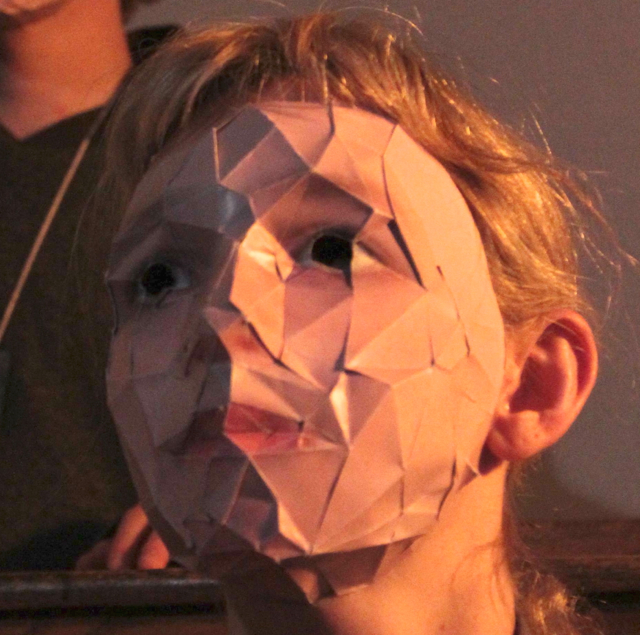
Image from The Blue Boy by Broken Talkers
THERE’S a ghost that haunts Artane, a part of Dublin where Ireland’s largest industrial school used to be. Schoolchildren there tell stories about “the blue boy”, who once came to a bad end at the school.
Sadly, he wasn’t the only child who suffered there – and not the only one who died. The survivors carried away the baggage of their past – the physical and psychological injuries it inflicted – when they were finally able to put the school walls behind them. BrokenTalkers’ The Blue Boy tells their stories in a production combining text, sound, images and physical performance.
Gary Keegan, co-artistic director of BrokenTalkers – together with director Feidlim Cannon – has a particular interest in this story. His grandfather, an undertaker, had been called into the school on several occasions to measure the body of a child who had died for his coffin. Sometimes, Keegan’s mother told him, he noticed bruises on the child’s body.
The Ryan Report confirmed the abuse of countless children
When it was published in Ireland in 2009, the Ryan Report confirmed this story – and many others besides. Eleven years in the making, this report encompassed thousands of pages and confirmed the abuse of countless young children who, as social undesirables, were brought to these industrial schools and reformatories – which were the care and responsibility of the Catholic Church. This shed a particularly glaring light on the children’s suffering, rendering their torturers not only sadistic, but also hypocritical.
Keegan and Cannon decided to make this the focus of a theatre piece. They not only read the Ryan Report but also interviewed dozens of former students of these schools. They were so shocked by what they heard it sometimes moved them to tears.
“I conducted the first interview myself,” Keegan remembers. A former industrial school student had recounted, 30 years later, that she and her fellow inmates had the job of making rosary beads. “She talks about being so hungry that she would eat the beads just to stave off the hunger. She said it in such a matter-of-fact way. It completely tore me apart. So we had to edit that interview because you can hear me in it getting upset.”
She ate rosary beads to stave off the hunger
Keegan and Cannon combined this and other stories – including Keegan’s own – with physical theatre into a unique production. Sombre images from the last century form the backdrop for masked performers to illustrate the children’s misery and desperation. Wearing masks fractured into cubistic impressions of faces, they demonstrate the broken lives and souls of the children and indicate how their humanity was taken from them. “So much of what they had to do was work related,” says Keegan. “The environment was dehumanising. They all had a number as opposed to a name. They had to do a lot of marching. And when they weren’t marching or working, they were probably beaten.” The choreography and physicality of the work reflect this.
Keegan denies, however, the occasional parallel drawn between the schools and the concentration camps of the Third Reich. “This is something that happened in Ireland in a different context: a context of abuse of care and trust, and collusion between the State and the Church. The Irish context is something we’re very keen for people to understand, the relationship between the Church and the State. The State were complicit in what happened. And they paid for it as well.”
When the Ryan Report was published, there was a huge outcry in Ireland. People were not only horrified by the abuse but also by the incredible extent of it, and that it took place under the auspices of the Catholic Church with the knowledge and complicity of the State. The shame was overwhelming. Creating a piece about the situation that dealt with its horrors was no easy task. “Sometimes,” Keegan reveals, “as a joke in our e-mails, we’d put in the subject line to our colleagues who were part of the crew, ‘The show that Failte Ireland doesn’t want you to see’.”
We’re proud of the way we’ve represented history
Keegan is nevertheless proud to be able to show the piece to an expanding and now international audience. The show had its German premiere at the New Plays from Europe festival in Wiesbaden, and in a few days will be presented at the Stuttgarter Europa Theater Treffen. Next year the piece will go to the Festival de Liège in Belgium, with hopefully a few more performances in Germany. “I think, and Feidlim might agree, I’m not necessarily proud that this is an Irish story, but I’m proud of the way we’re presenting it,” explains Keegan. “We’re representing Irish culture and theatre well by choosing to present this story in this way. It’s sending a message to whoever sees or experiences it that Ireland is a creative place.”
The production wouldn’t have been possible 20 years ago, Keegan believes. Today, “citizens are beginning to stand up more for truth”. And this is something else he’s proud of. “The story isn’t necessarily a positive one,” he admits,” but it leaves you with a sense there’s an opportunity to make things better, it’s not all lost. I think the show ends on a hopeful note.”
Perhaps then even the Blue Boy can rest in peace.